Closely observed detail and an ambitious imagination. Painting, drawing and printmaking brought together by one of the Northern Renaissance’s great artists.
Albrecht Dürer was born in Nuremberg in 1471. He first trained in his father’s goldsmith workshop before becoming an apprentice to the painter and printmaker Michael Wolgemut. The young artist learned to bring design, observation and skilled making into close relationship. His years as a travelling journeyman from 1490 to 1494 extended that education beyond his home city.
A goldsmith’s attention to detail gives us one way to appreciate Dürer’s pictures. A small contour needs to be clear, but it also belongs to a larger arrangement. Look at the relationship between a carefully described object and the space around it. The detail becomes expressive because it contributes to the picture’s structure, giving close observation a strong sense of purpose.
Pictures that reach a wider world
Dürer travelled to Italy and absorbed artistic ideas beyond northern Europe, while developing a substantial practice in painting, drawing and printmaking. His Apocalypse woodcuts, published in 1498, brought an ambitious series of images before a broad audience. The printed sheet allowed a forceful composition to travel, joining the intimate scale of a picture on paper with the drama of a larger story.
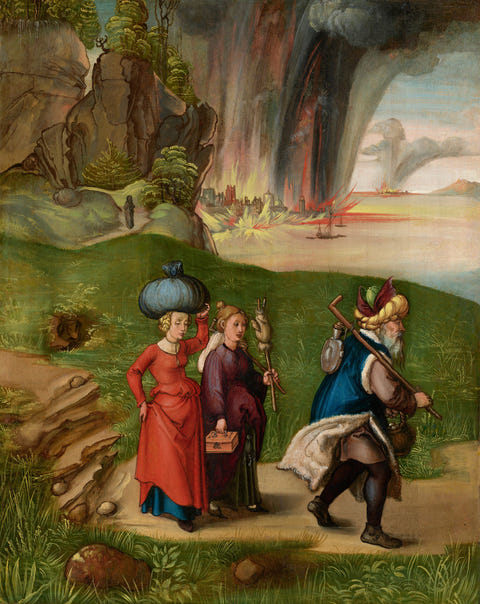
Lot and His Daughters shows that descriptive energy within a painted scene. Figures cross a green foreground while flames and dark smoke occupy the distance. The landscape holds small passages of plants, rocks and changing terrain alongside the larger event. Follow the route through the picture, then return to an individual detail: the two scales of looking continually enrich one another.
The pleasure of sustained attention
Dürer died in Nuremberg in 1528, leaving a body of work that continues to demonstrate the close relationship between looking and invention. His images invite patience because a precise detail can change how the wider scene is understood. The shapes of figures, objects and surrounding land form an arrangement in which description and dramatic emphasis support the same artistic purpose.
Begin with the main direction of a composition and notice what brings the eye back again. A sharply described fold or a small area of brightness can connect separate parts of the scene. Then look at the quieter passages around those points of attention. Dürer’s art offers a generous amount to discover, with each return revealing another relationship within the carefully organised whole.
Art to live with.
Fine-art prints on 200 gsm paper. Choose unframed or explore the available frame finishes, in a size that suits your space.