William Blake was born in London in 1757 and trained as an engraver with James Basire from 1772 to 1779. He then entered the Royal Academy Schools, developing an artistic life that joined image-making with poetry. The practical skills of engraving remained important, giving his imaginative work a foundation in the patient labour of designing and making a printed page.
Blake’s marriage to Catherine Boucher in 1782 brought an enduring partner into that work. She helped him produce his distinctive printed books, in which words and pictures could belong to one artistic invention. A page became more than a container for separate elements: line, colour and the placement of text gave the whole surface a rhythm and an expressive character.
Making imagination visible
Blake experimented with relief etching and used it for the illuminated books associated with his poetry. Biblical and literary subjects also supplied figures and stories for his paintings and designs. His art gives thought an unusually physical presence, using the turn of a body or the direction of an arm to make an imagined encounter feel immediate and emotionally clear.
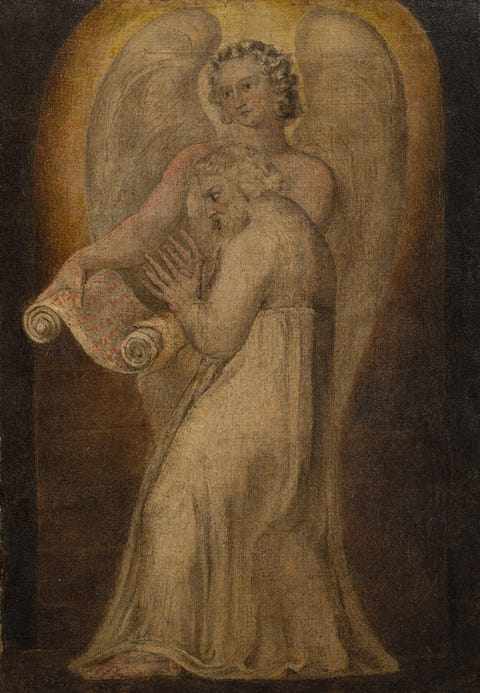
Saint Matthew offers a concentrated example. The evangelist responds to an angel presenting a scroll, with the figures emerging through warm light from a dark background. Look at the relationship between their hands, faces and flowing clothing. The scene’s intensity comes through those connected gestures, giving a quiet arrangement the weight of a revelation rather than an ordinary exchange between two people.
A vision that keeps its force
A small circle of patrons supported Blake’s unusual artistic ambitions during his lifetime. He died in 1827, leaving poetry, printed books, drawings and paintings that continue to invite close attention. His figures can feel both particular and symbolic, holding the character of an individual encounter while suggesting a wider world of belief, invention and the possibilities of the human imagination.
When looking at a Blake picture, begin with the direction of its main gesture. Notice how surrounding forms answer it, and how light gives one part of the scene greater emphasis. The image need not explain every detail to establish a powerful presence. Its force often lies in the relationship between a clearly shaped body and the extraordinary experience that body appears to undergo.
Printed faithfully.
Art from museum archives, without recolouring, retouching or AI enhancement. Printed on 200 gsm paper, in your choice of size and frame.