Odilon Redon was born in Bordeaux. Books, pictures and music nourished an imagination that would remain central to his art. He learned printmaking from Rodolphe Bresdin, then developed a powerful language in charcoal. Rather than treating art as a faithful record of the visible world, he made space for mystery, fantasy and associations that resist a single explanation.
Born in Bordeaux, Redon came to art through drawing, music and an unusually private imaginative life. The printmaker Rodolphe Bresdin became an important influence, introducing him to etching and fantastical imagery. Later, Henri Fantin-Latour helped him explore lithography. These encounters supplied practical means for turning an inward world into images that could circulate publicly.
From darkness to colour
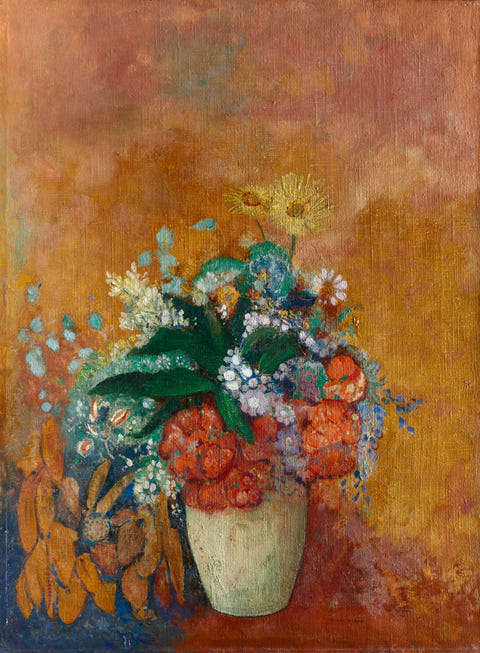
Redon’s charcoal drawings and lithographs, which he called his noirs, explored strange creatures, floating forms and dreamlike encounters. Later his work became celebrated for radiant pastel and painted colour. Mythological subjects and flowers offered ways to join observation with invention. A bouquet could remain recognisably botanical while its colour and setting opened onto a world of feeling.
His early reputation rested on the noirs: charcoal drawings and black-and-white prints populated by strange creatures, floating eyes and dreamlike spaces. During the 1880s his work reached Parisian audiences. From the mid-1890s, pastel and colour became more prominent, creating a transformation in mood without ending his interest in the ambiguous and the imagined.
The life of a flower
The birth of his son Ari in 1889 brought joy after the death of an earlier child. Family portraits sit alongside flowers and visionary subjects in the colour work of his maturity. Artists associated with the Nabis admired him. Ari later helped preserve his father’s work, carrying a deeply personal artistic world into public collections and a wider legacy.
Across his long career, Redon retained an attachment to the unexpected. His floral works invite a particularly slow kind of looking: a blossom becomes a small event in colour, and the surrounding space matters as much as the arrangement. Follow the light notes between petals and leaves. What begins as a still life can gradually acquire the atmosphere of a dream.
Printed faithfully.
Art from museum archives, without recolouring, retouching or AI enhancement. Printed on 200 gsm paper, in your choice of size and frame.