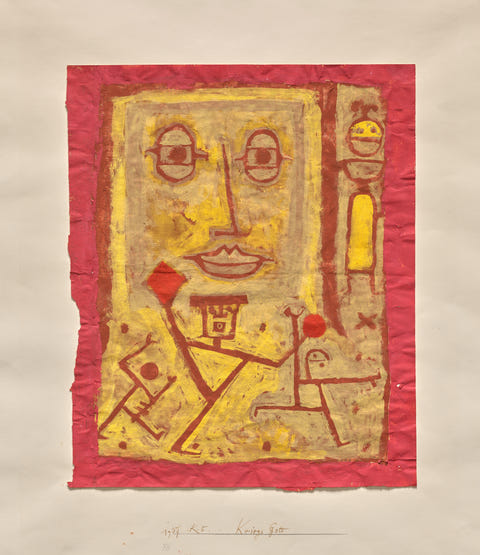
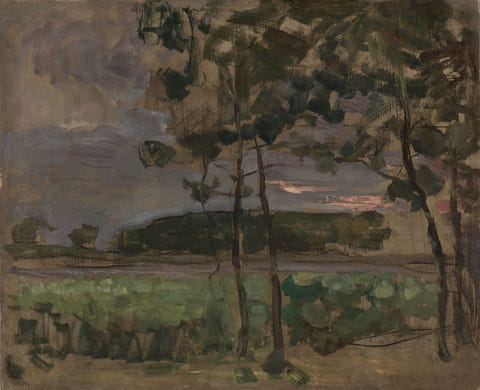
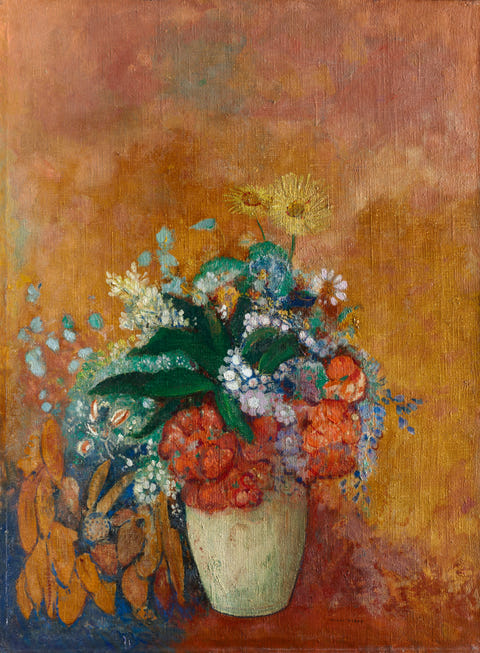
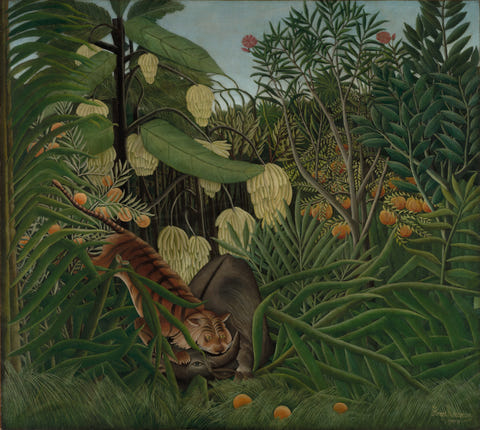
Paul Klee was born near Bern to a German music teacher and a Swiss mother. He grew up in a musical household before choosing to train as an artist in Munich. Drawing remained fundamental to his practice. His pictures bring a remarkably varied vocabulary of figures, symbols, arrows and colour arrangements into works that can be playful and deeply reflective at once.
Music remained an important companion to painting: Klee was a skilled violinist as well as a visual artist. His Munich training and encounters with contemporary art encouraged a gradual development rather than a single settled manner. He examined what a line, a sign or a relationship of colours could communicate, bringing analytical curiosity into even his most playful images.
Colour becomes independent
In Munich, Klee became involved with the Blue Rider circle around Kandinsky and Franz Marc. A journey to North Africa in 1914 helped transform his understanding of colour. It could become a pictorial element in its own right, rather than simply describing an object. His art moved freely between suggestion and abstraction, allowing imagined forms to arise from lines and patches of pigment.
Teaching at the Bauhaus from 1921 to 1931 gave him an opportunity to develop and share ideas about visual structure. His lessons investigated movement, growth and the relationships between forms. The classroom and studio supported one another, turning the practical process of making pictures into a sustained enquiry that influenced both artists and designers.
Pictures that keep thinking
In 1933 the Nazi authorities dismissed him from his teaching post in Düsseldorf, and he returned to Bern. Serious illness affected his later years, yet his output and imagery continued to change. Larger signs and more urgent forms belong to this final period, giving the late work a distinct character within an already remarkably varied career.
Klee’s work resists a single style or interpretation. Small signs can carry surprising emotional weight, while an apparently simple arrangement can open into a complex world. He died in 1940. Let the eye follow a line before deciding what it represents: the pleasure often lies in watching a shape become something, then retain the freedom to become something else.
Art to live with.
Fine-art prints on 200 gsm paper. Choose unframed or explore the available frame finishes, in a size that suits your space.