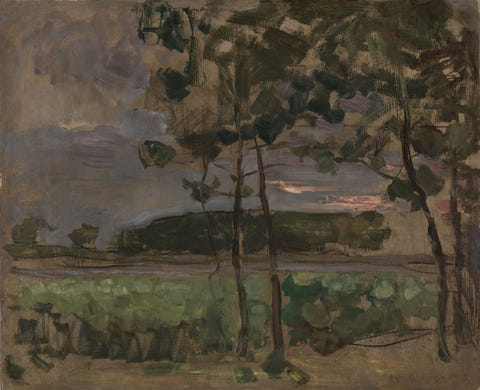
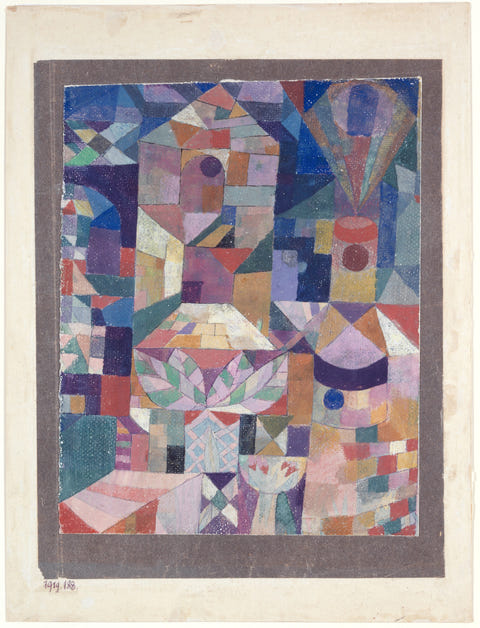
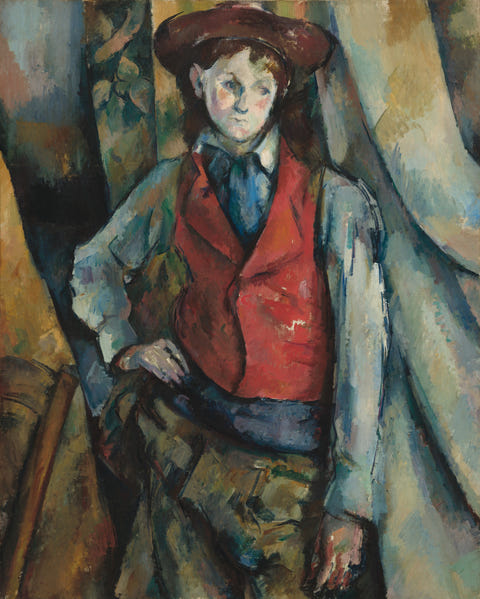
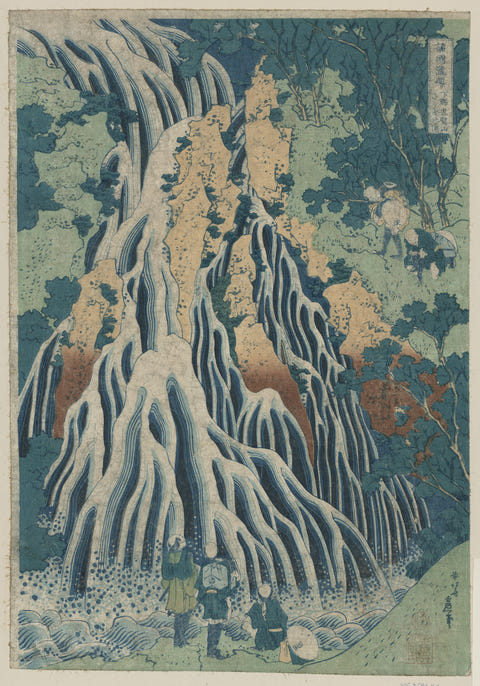
Piet Mondrian began by painting landscapes in the Netherlands. His route to abstraction was gradual, passing through increasingly distilled forms rather than arriving at a ready-made formula. Influences from Symbolism and Post-Impressionism encouraged him to seek a deeper structure within what he saw. Trees, buildings and landscape became starting points for an investigation of rhythm and balance.
Born in Amersfoort, he received early encouragement from an artistic family and trained in Amsterdam. Earning a living involved more conventional work while his own painting changed. His landscapes preserve a close relationship to Dutch fields, trees and buildings, making the later move toward abstraction the result of long investigation rather than a rejection of looking.
Toward a new language
A move to Paris in 1911 brought Mondrian into close contact with Cubism. He pushed its experiments toward a painting no longer dependent on representing visible things. In his mature work, horizontal and vertical lines, primary colours and areas of white became a complete vocabulary. Their relationships mattered more than the identity of any subject outside the picture.
During the First World War he returned to the Netherlands and became involved with the artists and writers around De Stijl. The group linked painting with architecture and design, giving his pursuit of a new visual order a wider context. Back in Paris, Mondrian continued refining the unequal intervals and carefully balanced relationships of his mature compositions.
Balance with energy
The threat of war took him from Paris to London in 1938 and then to New York in 1940. The city’s energy and boogie-woogie music helped inspire a fresh phase of painting. Broadway Boogie Woogie and the unfinished Victory Boogie Woogie show late experimentation, bringing a new pulse into the vocabulary he had developed over decades.
Mondrian’s geometric paintings are carefully organised but never merely regular. Different widths, intervals and areas of colour create movement within an apparently simple structure. He died in 1944, leaving an enduring influence on modern art and design. Look at the white spaces as actively as the coloured ones: the composition’s energy comes from the way every part changes the others.
Printed faithfully.
Art from museum archives, without recolouring, retouching or AI enhancement. Printed on 200 gsm paper, in your choice of size and frame.