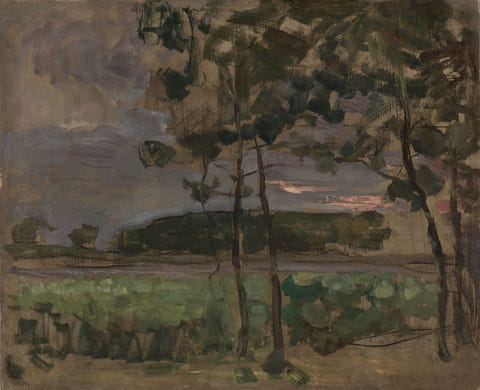
Field with Young Trees in the Foreground
c. 1907
Illustrative frame preview.
Kunstmuseum Den Haag, on loan to the Solomon R. Guggenheim MuseumOriginal work, 1912
A blue ginger pot anchors an arrangement of intersecting planes and muted colour. Mondrian breaks the surrounding objects into a compact structure of lines and facets while keeping the still life recognisable.
A fine-art giclée reproduction on 200 gsm uncoated paper. The complete composition is presented with a white paper border. Choose from the available sizes and unframed or framed finishes.
This Small edition has wider white margins, with the complete artwork measuring approximately 5.7 × 4.4 inches inside the 10 × 8 inch paper.
$29.00
Delivery to the contiguous US and Washington, DC.
Fine-art print on 200 gsm enhanced matte paper. Measurements are the paper dimensions, including the white border. Framing adds to the overall dimensions. The artwork keeps its approved composition within those margins. White, natural and dark wood frames are ready to hang with plexiglass.
A blue ginger pot anchors an arrangement of intersecting planes and muted colour. Mondrian breaks the surrounding objects into a compact structure of lines and facets while keeping the still life recognisable.
A fine-art giclée reproduction on 200 gsm uncoated paper. The complete composition is presented with a white paper border. Choose from the available sizes and unframed or framed finishes.
This Small edition has wider white margins, with the complete artwork measuring approximately 5.7 × 4.4 inches inside the 10 × 8 inch paper.
Dutch · 1872–1944
Piet Mondrian began by painting landscapes in the Netherlands. His route to abstraction was gradual, passing through increasingly distilled forms rather than arriving at a ready-made formula. Influences from Symbolism and Post-Impressionism encouraged him to seek a deeper structure within what he saw. Trees, buildings and landscape became starting points for an investigation of rhythm and balance.
A move to Paris in 1911 brought Mondrian into close contact with Cubism. He pushed its experiments toward a painting no longer dependent on representing visible things. In his mature work, horizontal and vertical lines, primary colours and areas of white became a complete vocabulary. Their relationships mattered more than the identity of any subject outside the picture.
Explore Piet Mondrian prints
c. 1907

1919
c. 1904

early 1830s