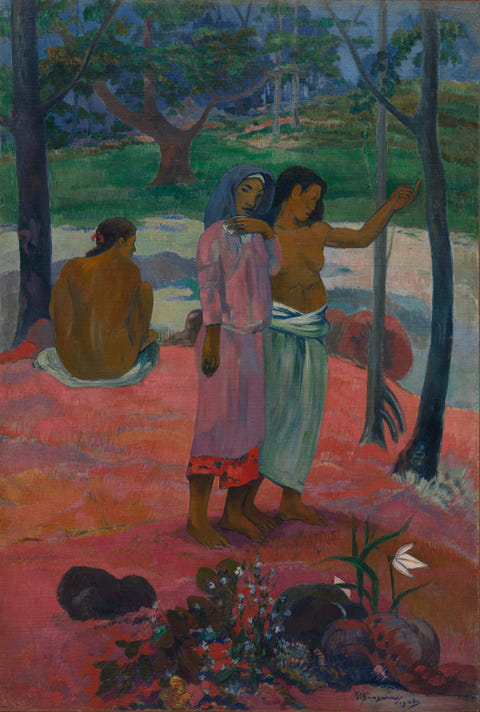
Henri Rousseau built his art largely through his own efforts while working for Paris’s municipal toll service. His familiar nickname, Le Douanier, outgrew the precise nature of that job. He pursued painting with determination despite criticism. The style he developed used clear outlines, carefully described forms and unusual spatial relationships, giving his pictures a presence unlike academic naturalism.
Rousseau was born in Laval and later worked in Paris as a toll collector. He developed his art largely outside formal training, earning the nickname Le Douanier. Exhibiting at the Salon des Indépendants gave this unconventional painter a public platform. His confidence in making pictures persisted despite ridicule from viewers who measured his work against academic expectations.
The jungle in the city
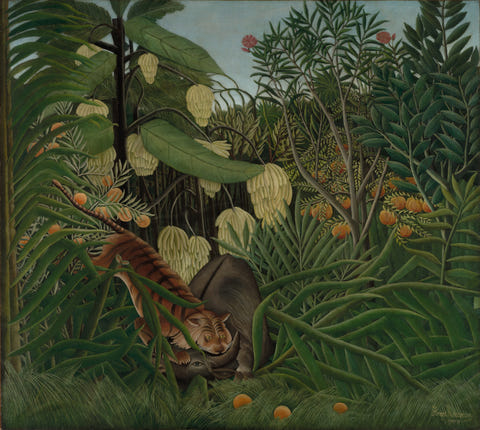
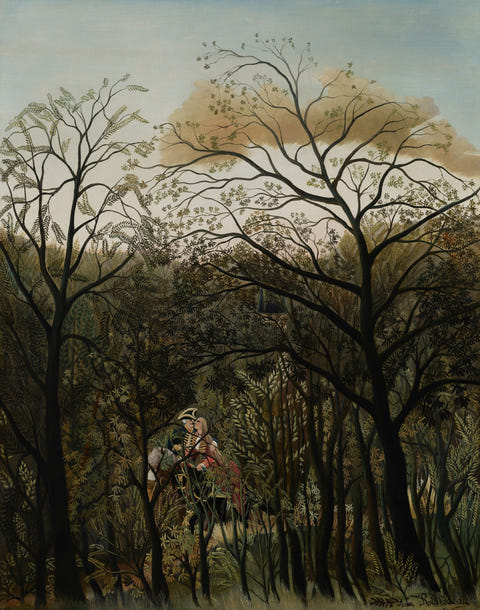
Rousseau never visited a tropical jungle. His extraordinary forests grew from imagination, popular images and visits to the botanical gardens and zoo in Paris. Giant leaves and watchful animals create spaces that feel both inviting and unsettling. He began his jungle paintings in 1891, returning to the subject with increasingly elaborate arrangements of foliage, figures and hidden activity.
The jungle paintings grew from imagination and observations made in Paris, including visits to the Jardin des Plantes. Rousseau never travelled to the tropical places he depicted. Botanical displays, illustrations and the city’s visual culture supplied material that he transformed into dense, invented environments, where unusual scale and stillness give a scene the logic of a dream.
An imagination recognised
Younger avant-garde artists increasingly recognised the originality of his approach. Picasso hosted a celebrated banquet in his honour in 1908, while Rousseau continued developing ambitious paintings. His last great jungle pictures brought familiar animals, foliage and figures together in unfamiliar relationships. Their influence rests in part on the conviction that a distinctive vision can overturn accepted rules of representation.
Younger artists and writers came to admire Rousseau’s independence. Picasso hosted a celebration for him in 1908, and his dreamlike combinations later offered a precedent for Surrealism. Rousseau died in 1910. His paintings still encourage us to suspend everyday expectations: look through the layers of leaves, and the forest becomes a stage where almost anything could happen.
Printed faithfully.
Art from museum archives, without recolouring, retouching or AI enhancement. Printed on 200 gsm paper, in your choice of size and frame.