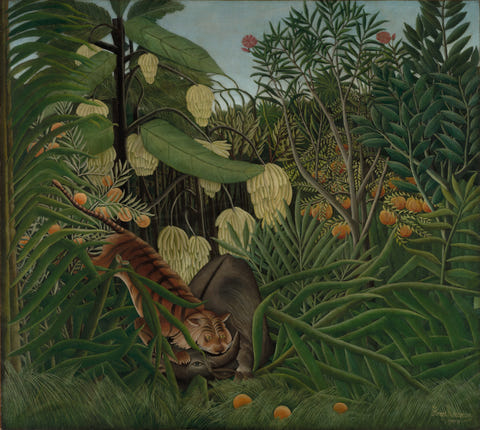
Henri Rousseau — Tropical Forest with Monkeys Print
1910
Illustrative frame preview.
Museum of Modern Art, New YorkOriginal work, 1897
The Sleeping Gypsy places a resting figure, a lion and a few carefully arranged objects beneath a bright moon. Clear contours and wide areas of blue create a dreamlike stillness, with the animal’s attention giving the scene its quiet tension.
A fine-art giclée reproduction on 200 gsm uncoated paper. The complete composition is presented with a white paper border. Choose from the available sizes and unframed or framed finishes.
$29.00
Delivery to the contiguous US and Washington, DC.
Fine-art print on 200 gsm enhanced matte paper. Measurements are the paper dimensions, including the white border. Framing adds to the overall dimensions. The artwork keeps its approved composition within those margins. White, natural and dark wood frames are ready to hang with plexiglass.
The Sleeping Gypsy places a resting figure, a lion and a few carefully arranged objects beneath a bright moon. Clear contours and wide areas of blue create a dreamlike stillness, with the animal’s attention giving the scene its quiet tension.
A fine-art giclée reproduction on 200 gsm uncoated paper. The complete composition is presented with a white paper border. Choose from the available sizes and unframed or framed finishes.
French · 1844–1910
Henri Rousseau built his art largely through his own efforts while working for Paris’s municipal toll service. His familiar nickname, Le Douanier, outgrew the precise nature of that job. He pursued painting with determination despite criticism. The style he developed used clear outlines, carefully described forms and unusual spatial relationships, giving his pictures a presence unlike academic naturalism.
Rousseau never visited a tropical jungle. His extraordinary forests grew from imagination, popular images and visits to the botanical gardens and zoo in Paris. Giant leaves and watchful animals create spaces that feel both inviting and unsettling. He began his jungle paintings in 1891, returning to the subject with increasingly elaborate arrangements of foliage, figures and hidden activity.
Explore Henri Rousseau prints