
Senecio
1922
Illustrative frame preview.
National Gallery of Art, WashingtonOriginal work, 1920
Klee arranges trees and buildings as small blocks of glowing colour. Thin lines divide the forms across a green ground, bringing the town and its planting into a shared rhythm.
A fine-art giclée reproduction on 200 gsm uncoated paper. The complete composition is presented with a white paper border. Choose from the available sizes and unframed or framed finishes.
£29.00
From museum archives. No recolouring, retouching or AI enhancement.
UK delivery. Unframed £4.99, free from £50. Wood-frame delivery included.
Fine-art print on 200 gsm enhanced matte paper. Measurements are the paper dimensions, including the white border. Framing adds to the overall dimensions. The artwork keeps its approved composition within those margins. White, natural and dark wood frames are ready to hang with plexiglass.
Our print guideKlee arranges trees and buildings as small blocks of glowing colour. Thin lines divide the forms across a green ground, bringing the town and its planting into a shared rhythm.
A fine-art giclée reproduction on 200 gsm uncoated paper. The complete composition is presented with a white paper border. Choose from the available sizes and unframed or framed finishes.
German, born in Switzerland · 1879–1940
Paul Klee was born near Bern to a German music teacher and a Swiss mother. He grew up in a musical household before choosing to train as an artist in Munich. Drawing remained fundamental to his practice. His pictures bring a remarkably varied vocabulary of figures, symbols, arrows and colour arrangements into works that can be playful and deeply reflective at once.
In Munich, Klee became involved with the Blue Rider circle around Kandinsky and Franz Marc. A journey to North Africa in 1914 helped transform his understanding of colour. It could become a pictorial element in its own right, rather than simply describing an object. His art moved freely between suggestion and abstraction, allowing imagined forms to arise from lines and patches of pigment.
Explore Paul Klee prints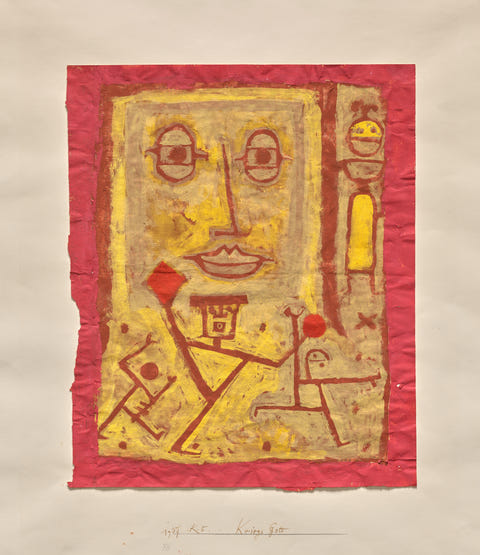
1922
c. 1907

c. 1880

1909