Born in the Netherlands, Vincent van Gogh worked as an art dealer, teacher and religious worker before committing to art at twenty-seven. He taught himself through drawing manuals, copying prints and observing the people around him. His early paintings gave labourers and rural life a seriousness usually reserved for grander subjects. His brother Theo became his closest supporter and correspondent.
His artistic education took him through Brussels, The Hague and the countryside of the Netherlands. In Nuenen he painted and drew the people who worked the land, culminating in The Potato Eaters in 1885. Theo’s financial help allowed him to keep working, while their letters reveal a thoughtful reader constantly testing ideas about art.
Finding his own colour
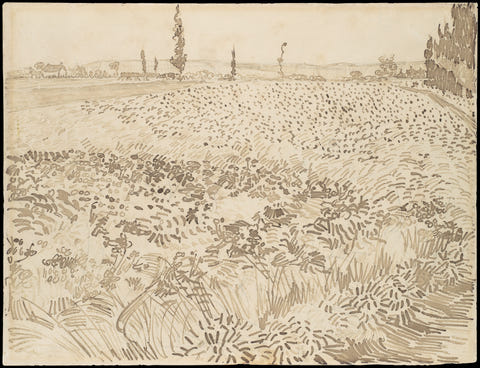
A move to Paris in 1886 brought him into contact with Impressionism and Japanese prints. His palette brightened and his brushwork became more distinct. In Arles, and later Saint-Rémy, he developed the rhythmic fields, restless skies and expressive portraits we recognise today. Painting remained a sustained discipline during periods of illness; the work records attention and invention as well as feeling.
Paris also brought friendships with painters including Paul Gauguin. Van Gogh hoped to establish a community of artists in Arles, where Gauguin joined him briefly in 1888. The partnership proved difficult. The following year he entered a hospital at Saint-Rémy, continuing to paint its garden and the surrounding landscape whenever his health allowed.
A way of seeing that endures
In Auvers he lived nearer Theo and came under the care of the physician Paul Gachet. His career as a painter lasted only about a decade, yet produced hundreds of canvases and drawings. After the deaths of both brothers, Theo’s widow Jo van Gogh-Bonger helped bring Vincent’s paintings and correspondence to a wider public.
Van Gogh spent his final months in Auvers-sur-Oise, working intensely before his death in 1890. Recognition grew after his lifetime, and his colour and brushwork helped open the way for Expressionism. Look closely at the direction of his strokes: a field, a tree or a face becomes a pattern of movement. These paintings reward both a first impression and years of looking.
Printed faithfully.
Art from museum archives, without recolouring, retouching or AI enhancement. Printed on 200 gsm paper, in your choice of size and frame.