Claude Monet was born in Paris and grew up in Le Havre on the Normandy coast. As a teenager he earned a reputation for caricatures, before Eugène Boudin introduced him to painting outdoors. In Paris he met Renoir, Sisley and Bazille. Together they began seeking an art rooted in contemporary experience, with colour and observation taking precedence over academic convention.
His early career was far from secure. Monet sought recognition at the Paris Salon while struggling to support a young family. Camille Doncieux, a frequent model in his early figure paintings, became his wife in 1870. Their life moved between Paris and towns along the Seine, where friends sometimes painted side by side.
The changing world
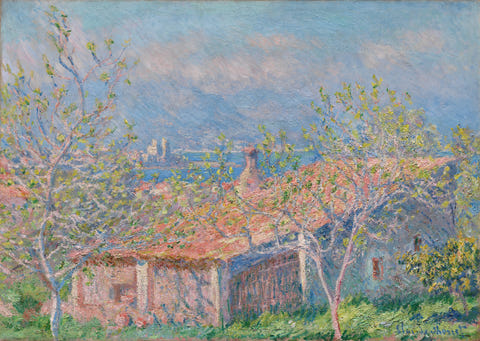
Monet helped establish Impressionism, taking part in the first independent exhibition in 1874. Rivers, gardens, seaside towns and modern life became subjects for rapid, broken brushwork. Later he returned to a single motif across whole series, exploring how weather, season and time alter its appearance. A subject was never simply finished: it could reveal something different in the next light.
The Franco-Prussian War took Monet to London, where he encountered British painting and the dealer Paul Durand-Ruel. Back in France, Argenteuil offered sailing boats, railway bridges and river light. Camille died in 1879. These years of uncertainty preceded the sustained commercial success that eventually allowed him to devote himself to increasingly ambitious series.
A garden without an ending
Giverny became both home and an evolving artistic project. Monet later married Alice Hoschedé and developed the garden around their household. In old age he continued painting despite cataracts. His great Water Lilies decorations, conceived as an enveloping environment, became a gift to France and were installed at the Orangerie after his death.
At Giverny, where he settled in 1883, Monet created the garden and water-lily pond that sustained his later painting. Reflections began to loosen the distinction between water, sky and plants. He continued to work into old age, leaving a vision of nature that approaches abstraction. Follow the colour across his paintings and the familiar world becomes a quietly changing surface.
Printed faithfully.
Art from museum archives, without recolouring, retouching or AI enhancement. Printed on 200 gsm paper, in your choice of size and frame.