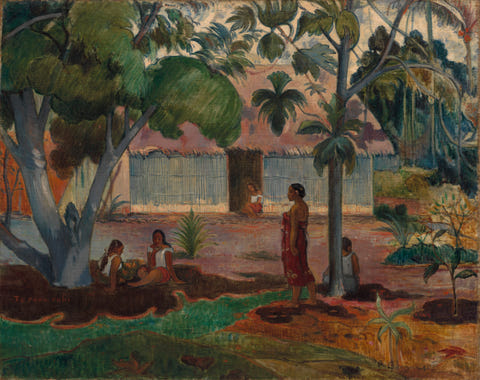
Arearea
1892
Illustrative frame preview.
National Gallery of Art, WashingtonOriginal work, 1884
Red peonies crowd a patterned vase beside objects spread across a table. Gauguin sets the dense flowers against a pale wall, with small pictures visible in the upper corner.
A fine-art giclée reproduction on 200 gsm uncoated paper. The complete composition is presented with a white paper border. Choose from the available sizes and unframed or framed finishes.
£29.00
From museum archives. No recolouring, retouching or AI enhancement.
UK delivery. Unframed £4.99, free from £50. Wood-frame delivery included.
Fine-art print on 200 gsm enhanced matte paper. Measurements are the paper dimensions, including the white border. Framing adds to the overall dimensions. The artwork keeps its approved composition within those margins. White, natural and dark wood frames are ready to hang with plexiglass.
Our print guideRed peonies crowd a patterned vase beside objects spread across a table. Gauguin sets the dense flowers against a pale wall, with small pictures visible in the upper corner.
A fine-art giclée reproduction on 200 gsm uncoated paper. The complete composition is presented with a white paper border. Choose from the available sizes and unframed or framed finishes.
French · 1848–1903
Paul Gauguin was born in Paris and spent much of his early childhood in Peru. After work in the merchant marine and navy, he became a stockbroker in Paris. Painting began as a pursuit alongside that career. He collected Impressionist art and worked with artists including Pissarro and Cézanne, before deciding to paint full-time in 1883.
Gauguin exhibited with the Impressionists but sought a language less dependent on recording light as it appeared. Strong colour, simplified forms and remembered or imagined subjects became central to his work. He painted, made prints, carved and worked in ceramics. His self-portraits and writing reveal an artist actively constructing and questioning his own public identity.
Explore Paul Gauguin prints