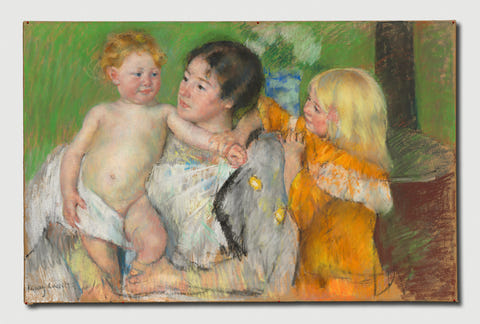
Mary Cassatt was born and educated in Pennsylvania and spent most of her artistic career in Paris. She began exhibiting at the Salon in 1868, then joined the independent Impressionist group. She was its only American participant. Her work drew on European painting and Japanese prints while retaining a distinctive interest in the lives, relationships and attention of women.
She studied at the Pennsylvania Academy of the Fine Arts before seeking further training in Europe. Paris offered museums, teachers and opportunities to exhibit, but professional independence still required persistence. Degas invited her to join the Impressionist circle in 1877. Exhibiting with the group opened a setting where she could pursue her own choices of subject and technique.
Painting and the printed image
Cassatt’s paintings are celebrated for intimate scenes of everyday experience, but printmaking was equally important to her invention. Working alongside Degas encouraged experiments in etching and other techniques. She embraced the medium’s demanding practical work, developing innovative colour prints. The clarity of Japanese print design helped inform her use of pattern, contour and unexpected compositional spaces.
The Japanese print exhibition in Paris in 1890 helped inspire a celebrated sequence of colour prints. Cassatt experimented with demanding combinations of processes to achieve broad colour, fine contours and delicate pattern. These were substantial technical achievements, bringing the everyday activities of women into compositions whose apparent ease conceals careful invention and sustained practical work.
An artist and an adviser
Advice to American collectors, including the Havemeyers, helped shape important collections of European art. Her influence therefore extended through both the pictures she made and the works she encouraged others to acquire. Failing eyesight eventually curtailed her practice, but her long career had already established a powerful example of artistic autonomy and an enduring transatlantic cultural connection.
Cassatt also shaped American appreciation of European art, advising collectors and encouraging acquisitions. Her career joined artistic independence with a wider cultural influence. She died in 1926. In her work, look beyond the familiar subject to the arrangement of hands, fabric and surrounding space: a carefully observed relationship becomes the structure of the entire picture.
Printed faithfully.
Art from museum archives, without recolouring, retouching or AI enhancement. Printed on 200 gsm paper, in your choice of size and frame.