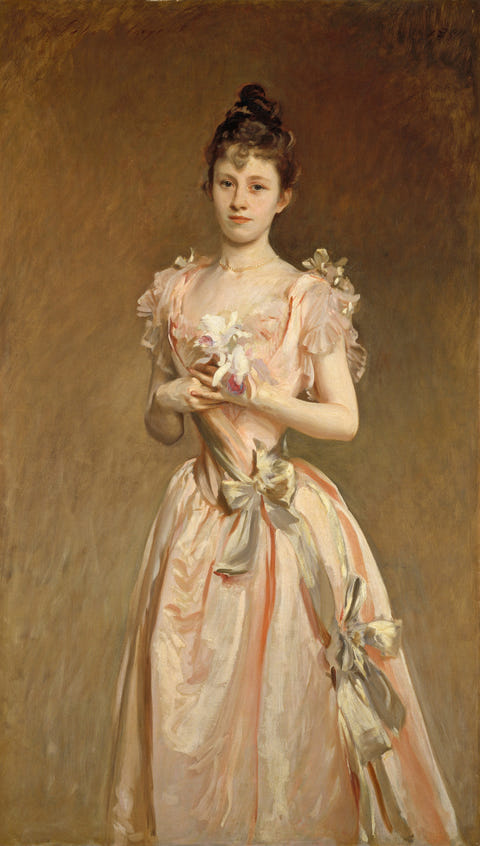
John Singer Sargent was born in Florence to American parents. His childhood involved travel across Europe, where his mother encouraged him to draw. Museums, mountains, people and architecture filled his sketchbooks. He trained in Paris with Carolus-Duran, developing an assured approach to painting that would help make him one of the most sought-after portraitists of his generation.
Carolus-Duran encouraged direct painting and a close study of Velázquez, helping Sargent develop his fluent handling of light and form. Paris also offered the official Salon as a route to recognition. His cosmopolitan upbringing made travel a permanent part of his practice, supplying subjects beyond the social world of the commissioned portrait.
Beyond the portrait studio
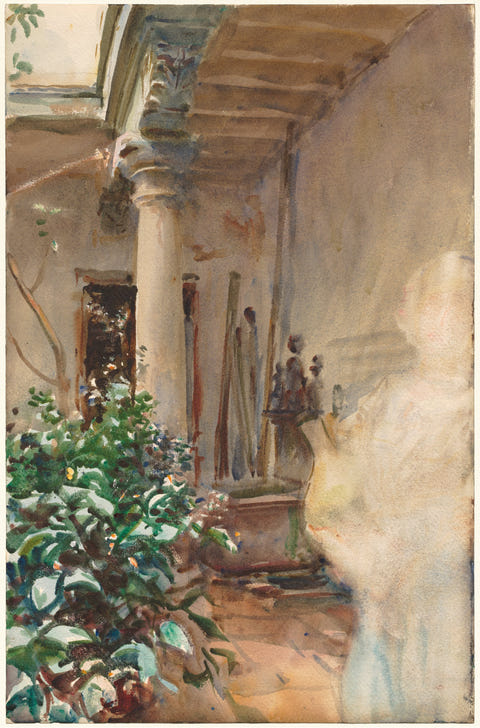
Sargent’s international reputation rested on society portraits, but everyday life and travel subjects attracted him from the beginning. He painted in Venice, Spain, North Africa and the Alps, among other places. After about 1905 he declined most portrait commissions and increasingly devoted himself to travel, watercolours and work connected with major mural projects in America.
The exhibition of Madame X in 1884 brought controversy rather than the success he had hoped for. Sargent moved to London in 1886 and rebuilt his position through portrait commissions. The episode became a turning point in an international career, while friendships and journeys continued to support paintings made for his own interest rather than a client’s requirements.
The freedom of looking
His later freedom from most portrait commissions allowed a more sustained pursuit of watercolour and travel subjects. At the same time, mural projects connected him with public institutions in Boston. The breadth of this work complicates the familiar image of a society portraitist: Sargent’s mature practice moved between intimate studies, demanding decorative schemes and the pleasure of painting outdoors.
Sargent’s studies away from the studio reveal the pleasure of following light across a surface. A few confident strokes can describe a sunlit wall, a piece of cloth or deep shade. He died in 1925. Look for the passages where description becomes especially economical: the apparent ease is part of a painter’s long training in seeing exactly what matters.
Printed faithfully.
Art from museum archives, without recolouring, retouching or AI enhancement. Printed on 200 gsm paper, in your choice of size and frame.