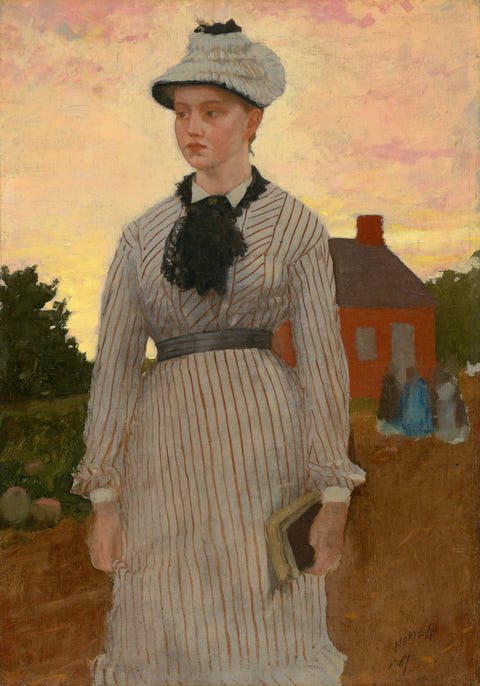
Winslow Homer developed a career across illustration, drawing, printmaking, watercolour and oil painting. His early illustrations of the American Civil War gave way to pictures of country life and the shore. Across these changing subjects he maintained a direct, searching interest in people and their circumstances, letting a scene’s physical details carry much of its meaning.
Born in Boston, Homer began with practical training in lithography before working as a freelance illustrator. Assignments connected with the Civil War brought him close to the lives of soldiers. Oil painting gradually became more important, while successful watercolours allowed him to leave illustration behind. His development joined professional craft with an increasingly independent choice of subjects.
Toward the sea
Nature became an increasingly powerful presence in Homer’s mature work. The shore offered both everyday human activity and a setting where weather could reveal forces beyond human control. His paintings can balance careful description with broad, decisive shapes. Watercolour gave him another means of investigating light and movement, extending the range of a practice that lasted five decades.
A stay in Cullercoats on England’s North Sea coast in 1881–82 marked an important turning point. He watched fishing communities at work, paying particular attention to women hauling fish, mending nets and waiting at the shore. The experience strengthened his interest in the relationship between ordinary human lives and the danger, labour and uncertainty of the sea.
The weight of a wave
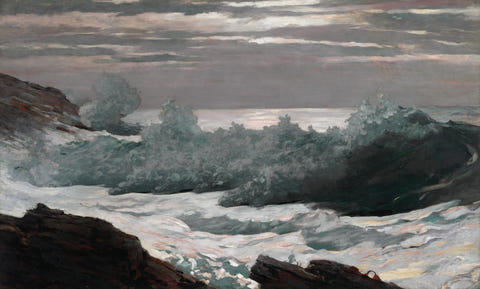
In 1883 he moved to Prouts Neck, Maine, establishing a home and studio near the rocky coast. Journeys to warmer places, including the Caribbean, supplied brilliant watercolours, but Maine sustained his great later seascapes. Increasingly the ocean itself became the subject, carrying the drama once expressed through figures into rock, water, foam and the movement of paint.
Homer guarded his privacy and seldom explained the meanings of his paintings, allowing the work to remain open to attention. His late images of nature are among his most compelling. Look at the meeting of rock, foam and horizon: scale becomes something felt as well as measured. The sea can fill a picture with movement while its composition remains remarkably firm.
Printed faithfully.
Art from museum archives, without recolouring, retouching or AI enhancement. Printed on 200 gsm paper, in your choice of size and frame.