Édouard Manet was born into a wealthy Parisian family. After unsuccessful attempts to enter naval college, he trained with Thomas Couture. Copying paintings in the Louvre brought him close to the work of Velázquez and other earlier painters. Their example helped him develop a direct, freely handled style that challenged the polished surfaces expected of academic painting.
His training with Couture lasted several years, but copying and travel offered alternatives to a single teacher’s methods. Manet established his own studio in 1856. Looking at earlier Spanish and Italian painting helped him develop a modern approach, making the connection between an admired old composition and a contemporary Parisian subject part of the picture’s challenge.
The shock of the present
Manet made contemporary Paris a principal subject, from bars and streets to portraits and provocative reinterpretations of older art. Olympia caused a scandal at the Salon in 1865. His modern subjects and bold handling encouraged younger painters who became the Impressionists. He also learned from their colour and freedom, while retaining a deliberate approach to composition and working methods.
Although closely associated with the Impressionists, he declined to participate in their independent exhibitions. He continued seeking recognition at the official Salon, even as rejection and controversy became familiar. Friendships with writers and artists sustained discussion around his work. The Dutch-born pianist Suzanne Leenhoff, his wife, also appears in paintings that bring the artist’s household into view.
A painting that looks back
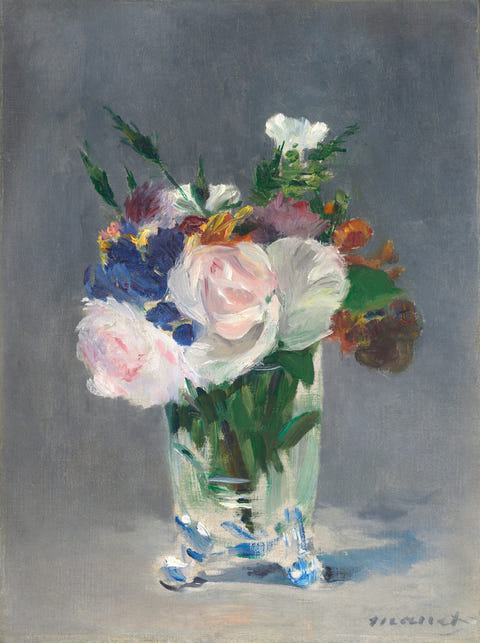
Illness changed the pace of his later work, but he continued painting portraits, flowers and ambitious modern scenes. Official recognition finally included a Salon medal and the Legion of Honour in 1881. After his death, a substantial exhibition at the École des Beaux-Arts revealed how far a once-contested painter had reshaped the possibilities of modern art.
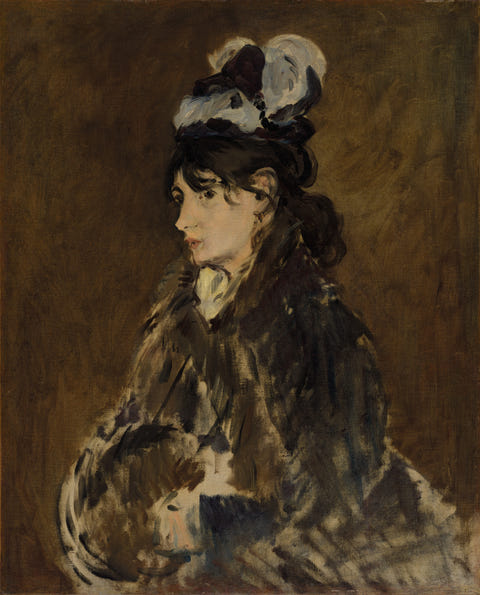
Manet’s work helped change the relationship between modern life and the painted image. His figures can seem strikingly self-possessed, meeting our attention without yielding easy explanations. He died in 1883. Look at the broad passages of dark and light in a portrait: their arrangement can be as revealing as the face, giving a moment of presence its lasting force.
Printed faithfully.
Art from museum archives, without recolouring, retouching or AI enhancement. Printed on 200 gsm paper, in your choice of size and frame.