Gustav Klimt was born in 1862 and trained at Vienna’s School of Applied Arts. His father was an engraver, and the relationship between fine art and skilled craft formed part of his early surroundings. Klimt began with substantial decorative commissions, working alongside his brother Ernst and Franz Matsch on paintings made for architectural settings and public interiors.
That early experience offers a useful way into his later pictures. A painted surface can act as an arrangement of related shapes, colours and repeating details. Look at how a figure meets its surroundings: clothing, ornament and background help determine the image’s pace. The eye moves between a recognisable person and the larger design that gives the picture its distinctive presence.
A new artistic world
In 1897 Klimt became a founder and the first president of the Vienna Secession. The group sought new possibilities for art around the turn of the century, bringing painting into conversation with architecture, sculpture and applied design. His own work became increasingly individual, with strong contours and decorative invention changing the relationship between a body and its surrounding space.
The Kiss, made in 1908–09, is his best-known example of a golden surface, but gold is only one part of his visual language. Pattern can carry its own movement through bright colour or the repetition of small forms. Notice where the detail gathers and where it loosens: those changes help guide attention, giving a densely worked picture room to breathe.
Finding the figure in the pattern
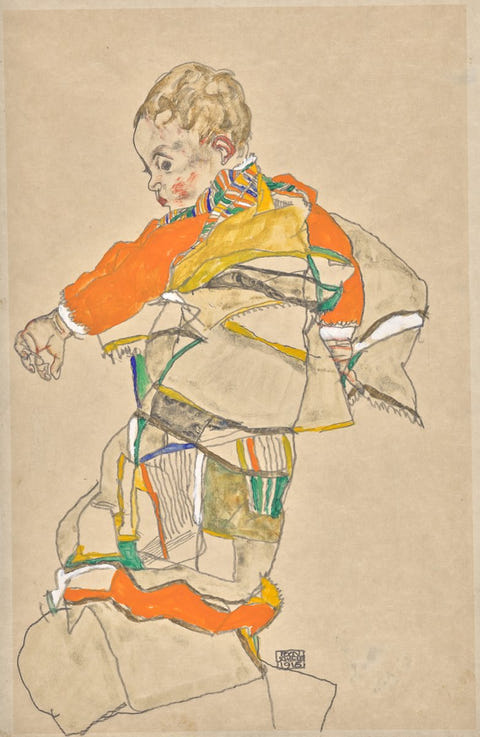
Baby (Cradle) invites a different scale of looking. The child’s small face occupies a picture filled with the colours and folds of surrounding fabrics. It is an intimate subject, but the arrangement turns the blankets into a substantial painted world. Follow one passage of colour across the surface and see how it meets another, with the figure held within those relationships.
Klimt died in Vienna in 1918. His pictures continue to reward attention because their surfaces offer more than decoration alone. A repeated form can steady a composition, while an unexpected colour brings a particular area forward. Begin with the whole arrangement, then move closer to its small variations. The connection between those two views gives his work much of its enduring appeal.
Printed faithfully.
Art from museum archives, without recolouring, retouching or AI enhancement. Printed on 200 gsm paper, in your choice of size and frame.