Born in Edo, now Tokyo, Hokusai trained in the craft of woodblock printing before joining the studio of Katsukawa Shunshō. He began with actor prints and book illustrations, then explored a remarkable range of subjects and styles. Over a working life spanning decades, he changed his artistic name repeatedly and treated each new phase as an opportunity to begin again.
As a child he was adopted into the household of a mirror maker, and as a young teenager he worked at cutting woodblocks. That practical familiarity with print production underpinned a restless artistic education. Leaving his first teacher’s school, he absorbed other Japanese traditions and explored new possibilities in illustrated books and privately commissioned prints.
Beyond the Great Wave
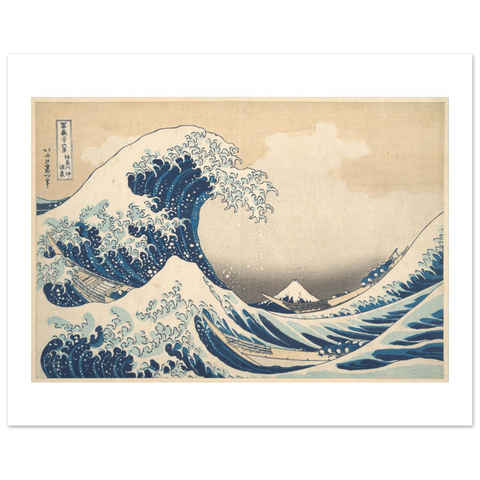
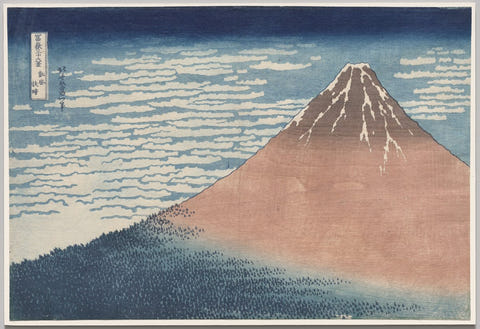
Hokusai’s interests extended from everyday gestures and animals to poetry, folklore and landscape. His drawing manuals shared that curiosity with a broad audience. In his seventies he made the celebrated Thirty-six Views of Mount Fuji, including The Great Wave. Unusual viewpoints, precise contours and bold areas of blue gave familiar landscapes a startling sense of scale and movement.
His popular Hokusai Manga volumes began appearing in 1814, bringing figures, creatures and observations of daily life together as material for learning to draw. Publication connected him with writers, publishers and other craftsmen. The Mount Fuji series was a late achievement in an already long career, rather than the beginning of his reputation.
Always beginning again
The later years brought family bereavements and financial pressures. Ōi, herself a gifted painter, returned to his household and assisted his work. Hokusai also travelled to Obuse, where the patron Takai Kōzan supported him. He remained devoted to improving his art into his eighties, making age a source of fresh ambition rather than retreat.
Hokusai continued painting into his final years, with his daughter Ōi working alongside him. His late pictures combine close observation with a deeply felt connection to their subjects. His designs remain compelling because every line has a job to do. In the wave’s curling shape and Fuji’s distant silhouette, drama and composure occupy the same small space.
Printed faithfully.
Art from museum archives, without recolouring, retouching or AI enhancement. Printed on 200 gsm paper, in your choice of size and frame.