Henri Matisse was born in northern France in 1869. Initially trained for a legal career, he turned toward art in his early twenties. Painting became the centre of a long and varied practice that also included drawing, sculpture, printmaking, book illustration and, later, paper cut-outs.
His work invites us to consider colour as an active part of the arrangement. In the portrait known as The Green Stripe, the face remains clear even though its colours depart from everyday appearances. Look at the meeting of one area and the next: each changes the feeling of its neighbour. The picture’s clarity emerges from those relationships, allowing a familiar human subject to acquire an unusually direct visual presence.
The freedom of colour
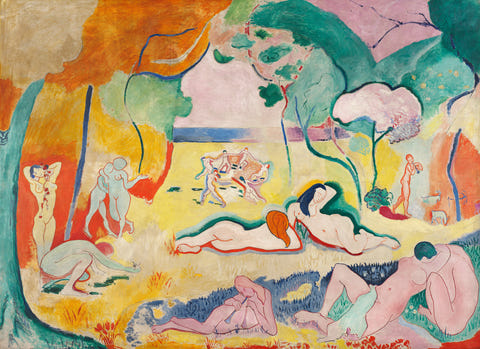
Matisse was a leading figure in Fauvism, the movement associated with intense colour in the early twentieth century. The Green Stripe and The Joy of Life belong to this important period. He continued developing his art over subsequent decades, repeatedly finding new means for closely related visual questions.
The Joy of Life spreads figures through a landscape of broad coloured areas. Curves guide the eye from a near body toward the smaller group in the distance. Space feels open, yet the surface remains firmly arranged. Compare that expansive scene with the concentrated portrait of Madame Matisse. In both, the relationship of colour and outline gives the subject its structure, asking the viewer to look across the complete picture rather than at one isolated detail.
Many means of making
Matisse’s later cut-outs extended his use of coloured shapes into a different working method. Throughout his career he returned to the figure, the interior and the possibilities of a simplified form. He died in Nice in 1954, leaving a body of work that continued to affect the direction of modern art.
The apparent ease of a Matisse is a useful invitation to slow down. Trace a curve and notice where it ends; compare a large field of colour with the small shape beside it. Then step back so the whole arrangement becomes visible again. What first seems spontaneous often proves carefully held together, with each interval and each change of colour contributing to a strong, spacious and memorable whole.
Art to live with.
Fine-art prints on 200 gsm paper. Choose unframed or explore the available frame finishes, in a size that suits your space.