Alphonse Mucha was born in Ivančice in 1860 and became one of the most recognisable artists associated with Art Nouveau. His reputation grew dramatically in Paris after his poster for Sarah Bernhardt’s Gismonda appeared in 1895. The commission placed his decorative language before a wide audience, bringing an illustrator’s attention to line into the public life of the city.
The appeal of his work extended beyond a single poster. Figure, lettering, ornament and surrounding space could belong to one coherent design. A long curve or a repeated floral form gave the image continuity, inviting the eye to move around the surface rather than settle on one isolated detail.
Nature becomes ornament
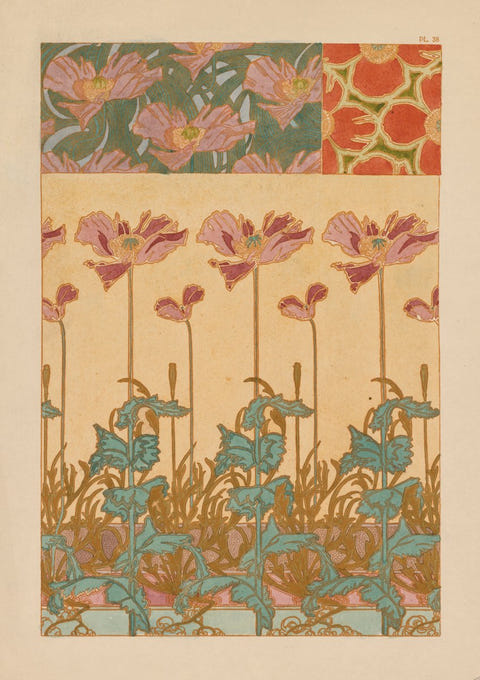
Mucha worked across posters and decorative designs, treating practical objects as opportunities for artistic invention. Documents décoratifs, published in 1902, offered designers examples of motifs and their applications. Flowers and leaves became the material for patterns that could retain the character of a plant while taking on a clear ornamental structure.
The botanical sheets in this collection show that movement between observation and design. Poppies and sweet peas have distinctive shapes, but their stems, petals and leaves also create a repeated visual rhythm. Look at how a flower can remain individually legible while contributing to the larger panel. The pleasure lies in both scales of looking.
Beauty in everyday design
Mucha’s decorative work formed part of a wider ambition to bring art into everyday surroundings. His designs offer more than lavish detail: they organise that detail through balance, repetition and a strong sense of contour. His career continued well beyond his Parisian fame, and he died in 1939.
The botanical images remain especially approachable examples of his visual language. Their quieter colours allow line and pattern to do much of the work. Notice the spaces between the leaves as well as the leaves themselves, and the way each panel holds the eye within its borders. A familiar flower becomes a complete decorative world, with its own pace and order.
Art to live with.
Fine-art prints on 200 gsm paper. Choose unframed or explore the available frame finishes, in a size that suits your space.