Pierre-Joseph Redouté became one of the best-known botanical artists of his era. Born in 1759, he built his career in France, bringing a painter’s sensitivity to the close study of flowers. His work sits at the meeting of art and botany: the defining features of a plant remain clear, while its colour, curves and changing surfaces become the subject of careful attention.
He was born in Saint-Hubert, in present-day Belgium, into an artistic family. Early work included portrait painting and decoration before he settled in Paris. The botanical painter Gérard van Spaendonck helped develop his skills in watercolour and plant illustration. This specialised training connected exact observation with the elegant handling that would distinguish his mature pictures.
Gardens and great publications
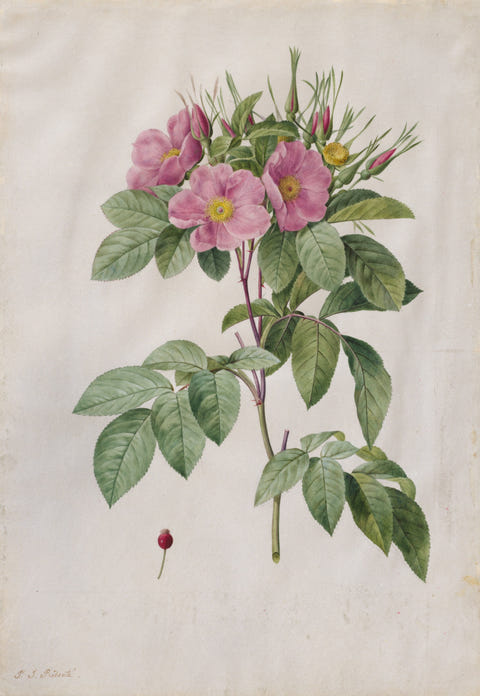
Redouté was associated with the French court and with the gardens of Malmaison. He illustrated important botanical publications, including works connected to Joséphine de Beauharnais. His watercolours of roses, lilies and other flowers made individual plants into complete compositions. A stem provides structure, leaves supply rhythm, and the flower becomes an intricate centre of colour.
Marie-Antoinette became an early royal patron; Joséphine later supported his work with the plants cultivated at Malmaison. Redouté’s career survived profound changes in French political life. Les Liliacées, published in eight volumes between 1802 and 1816, brought flowers into a major collaboration between painter, botanists, engravers and printers, rather than an isolated series of decorative studies.
The pleasure of precision
Les Roses followed between 1817 and 1824, with botanical text by Claude-Antoine Thory. Its carefully produced plates helped give Redouté an international audience and an enduring association with the rose. The original paintings and printed editions reveal a patient professional practice, where botanical clarity and the pleasure of looking were developed together over many years.
Redouté died in 1840, leaving images that continue to shape the familiar language of botanical art. Their clarity gives the eye space to notice differences: the fold of a petal, the angle of a leaf, the weight of a flowerhead. A single specimen can feel abundant. These are pictures for returning to, as the smallest details gradually come into focus.
Printed faithfully.
Art from museum archives, without recolouring, retouching or AI enhancement. Printed on 200 gsm paper, in your choice of size and frame.