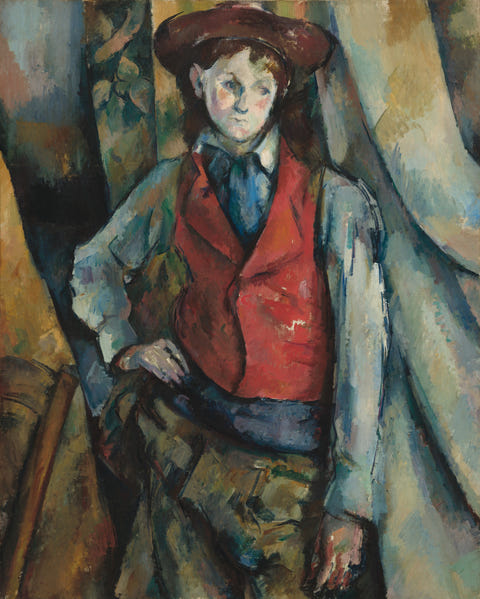
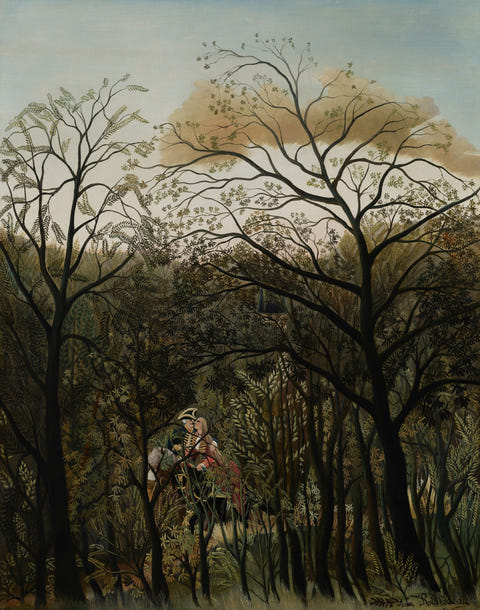
Paul Gauguin was born in Paris and spent much of his early childhood in Peru. After work in the merchant marine and navy, he became a stockbroker in Paris. Painting began as a pursuit alongside that career. He collected Impressionist art and worked with artists including Pissarro and Cézanne, before deciding to paint full-time in 1883.
His early adult life joined travel with the more settled responsibilities of a Parisian household. The move into painting followed years of looking, collecting and working among contemporary artists. Choosing art as his principal occupation changed his financial circumstances and family life, making the familiar story of artistic independence one that involved difficult practical consequences.
Beyond an optical impression
Gauguin exhibited with the Impressionists but sought a language less dependent on recording light as it appeared. Strong colour, simplified forms and remembered or imagined subjects became central to his work. He painted, made prints, carved and worked in ceramics. His self-portraits and writing reveal an artist actively constructing and questioning his own public identity.
Work in Brittany supplied opportunities to move beyond Impressionism through simplified shapes and emphatic colour. A period with Van Gogh in Arles in 1888 brought two forceful artistic temperaments together, but ended unhappily. Gauguin’s search extended across different media, using the surface of a print, a carved object or a painting to test related ideas.
The power of a colour relationship
He travelled to Tahiti in 1891 and later lived in the Marquesas Islands. His Pacific paintings combine observation with memory, invention and an active presentation of himself as an outsider to European society. These works became influential for their formal freedom, particularly the ability of colour and simplified contour to establish meaning without relying on naturalistic description.
Gauguin’s later career took him to the Pacific within a colonial world that shaped his subjects and their interpretation. His artistic innovations had a substantial effect on twentieth-century painting. He died in 1903. Look at how a large area of colour changes the feeling of the shapes beside it: the picture’s mood can emerge before its story does.
Printed faithfully.
Art from museum archives, without recolouring, retouching or AI enhancement. Printed on 200 gsm paper, in your choice of size and frame.