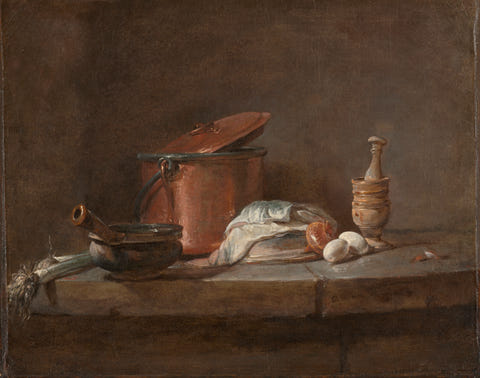
Jean-Siméon Chardin was born in Paris, the son of a craftsman. He trained in painters’ studios and was admitted to the Royal Academy in 1728 as a painter of animals and fruit. His art found distinction in subjects often considered modest: still lifes and domestic scenes became opportunities for exceptionally attentive painting rather than displays of grand historical drama.
Chardin was born in Paris, the son of a craftsman who made billiard tables. His training included work with established painters, before he entered the Royal Academy in 1728 on the strength of still-life paintings. The Ray and The Buffet announced an artist capable of giving ordinary things considerable presence without depending on grand historical subjects.
The substance of things
Chardin’s carefully constructed pictures describe both the appearance and the feel of objects. Dutch domestic painting offered an important example. His figure scenes explore work, education and family life, while his still lifes organise familiar materials into harmonious relationships. Critics admired the way his handling could make paint seem to hold the very substance of the things depicted.
Domestic figure scenes broadened his practice, bringing household work, childhood and quiet concentration into view. His first wife, Marguerite Saintard, died in 1735; he married Françoise-Marguerite Pouget in 1744. Success within the Academy and rooms in the Louvre placed him within the official artistic world, even while his pictures remained devoted to unusually modest subjects.
A quieter kind of richness
In his final decade he turned to pastel, making searching portraits that brought a new medium into a long-established career. Personal loss included the death of his son, also an artist. Chardin died in 1779. His example endured through the conviction that a few objects or an ordinary household gesture could sustain painting of exceptional seriousness and feeling.
Chardin returned to still life later in his career and also made pastel portraits. He died in Paris in 1779. His paintings remain rewarding because their calm is built from close decisions: a soft edge, a muted colour, a small reflected light. Give the eye time to settle and ordinary objects begin to acquire a presence of their own.
Printed faithfully.
Art from museum archives, without recolouring, retouching or AI enhancement. Printed on 200 gsm paper, in your choice of size and frame.