A night sky in motion. A vase of sunflowers. A bedroom you can recognise at a glance. Some of Van Gogh’s paintings are so familiar that they arrive with a story already attached. But there is a great deal to discover beyond those first encounters.
Here are five paintings we think deserve a longer look. ‘Underrated’ is our editorial judgement, rather than a ranking of popularity or value. Together, these works show how much Van Gogh could find in an ordinary object, a family gesture or the arrival of spring.
1. The Flowering Orchard, 1888
Van Gogh painted this orchard during his first spring in Arles. The Metropolitan Museum of Art records that he made fourteen canvases of blossoming orchards between late March and late April 1888. Here, the branching trees give the composition a delicate, almost drawn quality; the museum connects their angular forms with his admiration for Japanese prints.
What makes it rewarding is the balance between freshness and structure. The eye follows one branch, then another, before returning to the ground below. A scythe and rake quietly suggest the people who tend the orchard, even though no one appears in the scene.
Look for the way a small, familiar landscape becomes an arrangement of lines. This is a good painting to spend time with when you want to notice Van Gogh’s decisions, rather than simply recognise his signature brushwork.
2. Shoes, 1888
A pair of worn shoes is hardly a grand subject. That is part of the painting’s appeal. Van Gogh gives their creases, openings and uneven shapes enough attention to make a still life feel almost like a portrait.
This particular version was painted in Arles in 1888. The Met identifies the tiled floor with the Yellow House, where Van Gogh lived. The shoes’ owner remains uncertain: the museum discusses possible connections with a local sitter, Patience Escalier, without treating that attribution as settled.
Notice how much character comes from placement and texture. You do not need to know who wore the shoes to sense their use. It is a reminder that the everyday can hold a room’s attention as strongly as a spectacular view.
3. Oleanders, 1888
Flowers, a jug and a book: an ordinary tabletop becomes a lively meeting of shapes. The Met dates Oleanders to 1888 and places it in Van Gogh’s time in Arles. It identifies the book beside the flowers as Émile Zola’s La Joie de vivre.
There is something pleasingly untidy about the arrangement. The long leaves reach out from the vase while the flower heads gather in softer clusters. The book gives the composition a different kind of weight: a flat, everyday object beside an abundance of growing things.
Try looking at it first as a whole, then following just the leaves. The contrast between their pointed shapes and the blossoms keeps the scene moving. For us, its appeal lies in that combination of domestic familiarity and restless energy.
4. First Steps, after Millet, 1890
This is Van Gogh in conversation with another artist. Painted in 1890, First Steps reworks a composition by Jean-François Millet. The Met explains that Van Gogh used a black-and-white reproduction, interpreting the scene through colour rather than copying a coloured original.
The subject is wonderfully direct: a child learning to walk between the adults who support and encourage them. The space between those figures matters as much as the figures themselves. It creates a small moment of suspense that anyone who has watched a child take a first step can understand.
The painting offers a useful way into Van Gogh’s admiration for other artists. His originality did not require every subject to begin with him. Here, the act of interpretation becomes the work’s character.
5. Roses, 1890
Roses belongs to a group of flower still lifes Van Gogh painted in May 1890, shortly before leaving Saint-Rémy. The Met describes four related compositions, including its own Roses and Irises, that were conceived together.
The painting also changes how we think about colour in museum collections. Its roses were originally pink; the museum notes that those pigments have faded, leaving traces of their earlier colour. The pale blooms we see today are therefore part of the work’s material history, as well as part of its present beauty.
Spend a moment with the gathering of petals and leaves. The scene feels intimate, yet the flowers have a substantial presence. It is a fitting final stop: a familiar subject with more to reveal once you know where to look.
Look beyond the first impression
A useful way to explore an artist is to move between the celebrated works and the quieter ones. Look for a repeated subject, an unexpected influence or a detail you would normally pass over. Recognition can be the beginning of a relationship with a painting; it does not have to be the end.
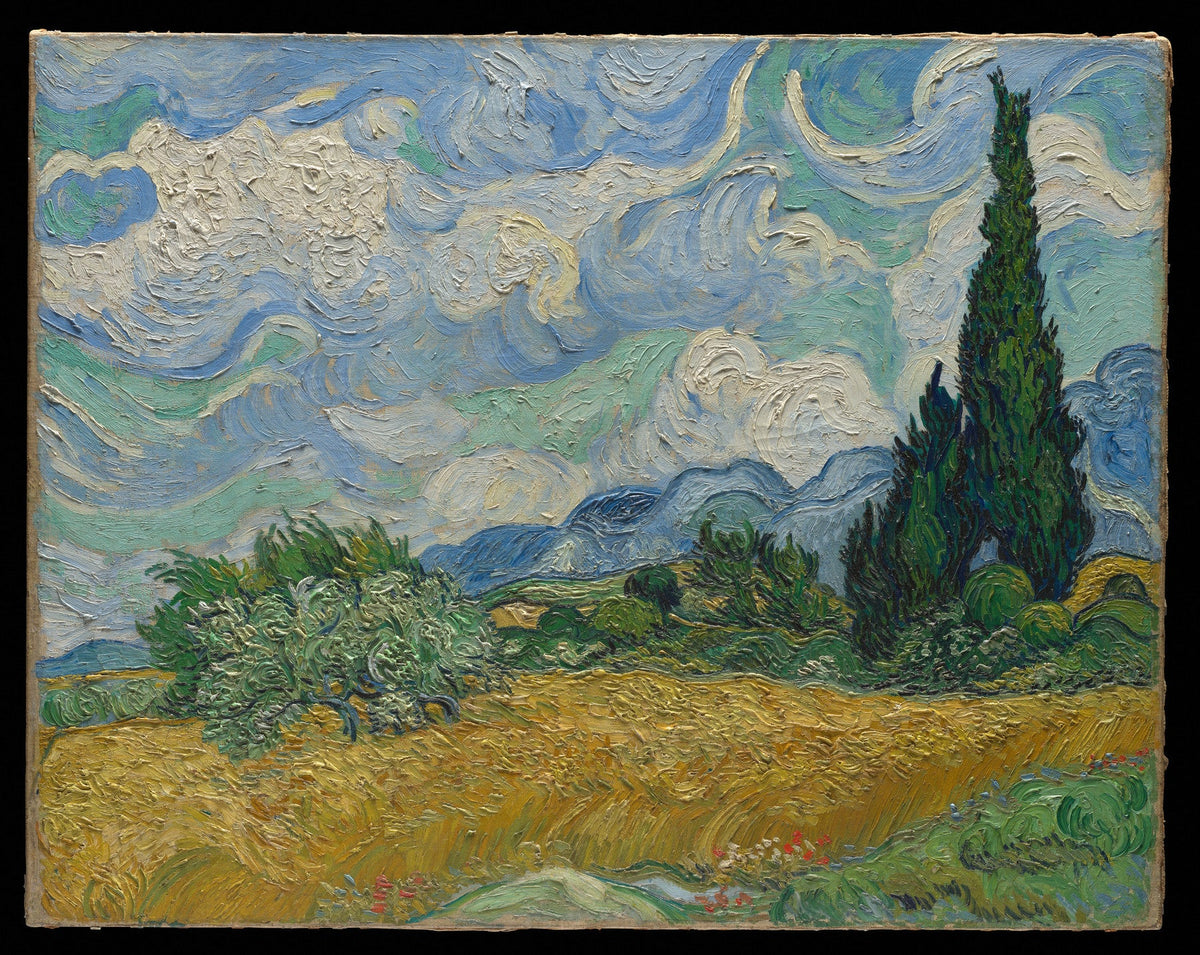
Our Van Gogh collection begins with Wheat Field with Cypresses and Self-Portrait with a Straw Hat. Both invite the same kind of slower looking: follow the rhythm of the landscape, or the individual strokes that build a face.