Choosing a painting for your home begins with how you want a room to feel. Calm and open? Warm and full of life? A little more dramatic? Monet offers all of those possibilities, often within subjects that seem familiar at first glance.
These ten choices are an editorial selection, with room suggestions based on our own reading of the paintings. They are an invitation to explore Monet, rather than a catalogue of ten prints currently available from Mayfair. Start with the atmosphere you love, then think about scale, light and the colours already around you.
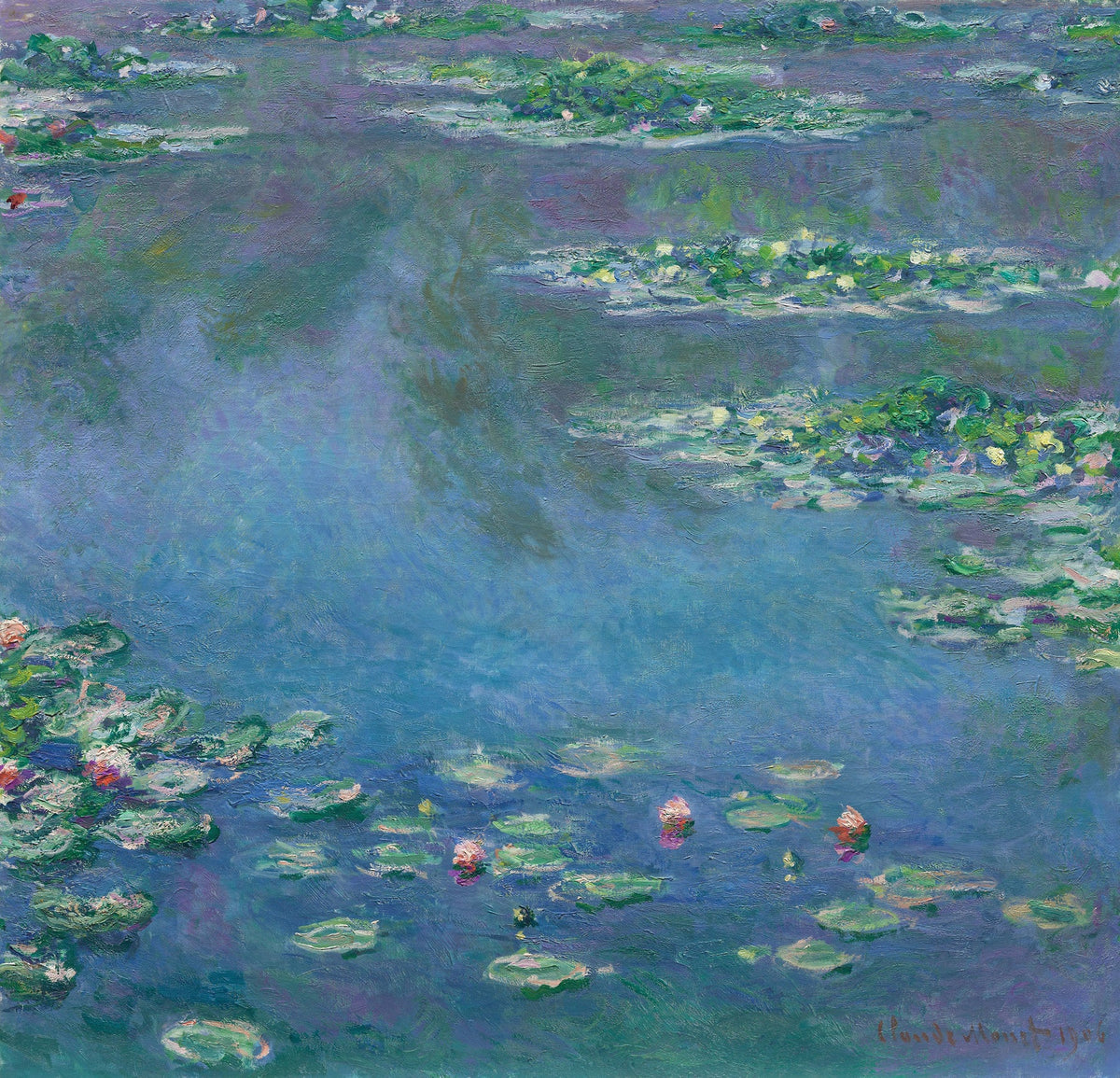
1. Water Lilies, 1906
A pond, floating flowers and reflections: this version of Water Lilies rewards looking without asking you to follow a busy story. The Art Institute of Chicago dates the painting to 1906. It brings the viewer close to the water’s surface, with the reflections and lily pads sharing the same space.
Our room suggestion: a bedroom, reading corner or living room where you want a gentler pace. Give the work breathing room and let its layered colour sit beside simple materials. This is the Monet in our first print collection.
2. Bridge over a Pond of Water Lilies, 1899
If you enjoy the garden subject but want a clearer focal point, begin with the bridge. The Met’s 1899 painting places its arch within the thick planting of Monet’s water garden at Giverny. The structure gives the eye somewhere to settle before exploring the surrounding scene.
Our room suggestion: a space with wood, plants or green accents. The bridge offers a strong shape that can hold its own beside furniture, while the garden keeps the mood soft.
3. Garden at Sainte-Adresse, 1867
This is a different kind of outdoor pleasure: a flower-filled terrace looking out towards the sea. The Met dates Garden at Sainte-Adresse to 1867. Flags, figures and the horizon create a scene with both immediate detail and a sense of distance.
Our room suggestion: a dining area or bright shared room. It brings a sociable, open-air atmosphere that pairs well with spaces used for conversation. Look at the painting from across the room as well as close up; the terrace’s structure is part of its appeal.
4. The Artist’s Garden at Vétheuil, 1881
A path, steps and towering sunflowers turn a garden into a route for the eye. The National Gallery of Art dates this work to 1881. The arrangement makes you feel that you could enter the scene, rather than simply look at it from a distance.
Our room suggestion: an entrance hall or a room that needs a touch of warmth. Its garden abundance can make a welcoming first impression. Keep nearby decorative objects relatively simple so the painting’s detail has space to work.
The Artist’s Garden at Vétheuil at the National Gallery of Art ↗
5. Woman with a Parasol — Madame Monet and Her Son, 1875
A figure standing against a sky can give a room a wonderful sense of openness. In this 1875 work, held by the National Gallery of Art, the parasol and moving fabric make the outdoor setting feel immediate. There is a person to connect with, as well as a landscape to enjoy.
Our room suggestion: a light sitting room or bedroom. It is a good place to begin if you love Monet’s atmosphere but prefer a human presence to a purely natural subject.
6. Cliff Walk at Pourville, 1882
Coastal art does not need to feel decorative or predictable. The Art Institute of Chicago’s Cliff Walk at Pourville, dated 1882, brings together a headland, sea and two figures. The landscape offers a feeling of distance while the people help us imagine being there.
Our room suggestion: a living room or work space where an expansive view would be welcome. Choose it for its atmosphere, whether or not your home is near the coast.
7. Stacks of Wheat (End of Day, Autumn), 1890/91
A simple rural subject becomes a study in the feeling of light. This painting, dated 1890/91 by the Art Institute of Chicago, belongs to Monet’s repeated explorations of wheat stacks. The title directs our attention to both season and time of day.
Our room suggestion: a space with earthy colours and tactile materials. Let the painting’s atmosphere guide the choice, rather than trying to match every colour exactly. It is especially appealing if you want a landscape with a strong, uncomplicated central form.
8. Palazzo da Mula, Venice, 1908
Monet’s Venice gives architecture the shifting quality of a reflection. The National Gallery of Art dates Palazzo da Mula, Venice to 1908. The building and the water below it invite you to look at the relationship between solid structure and moving light.
Our room suggestion: a room with restrained furnishings that could use a more romantic focal point. This is a choice for someone drawn to water and atmosphere, but also to the detail of a city.
9. The Houses of Parliament, Sunset, 1903
Familiar architecture can become almost dreamlike when its edges soften into atmosphere. In the National Gallery of Art’s 1903 painting, Parliament is seen through a coloured haze, with the setting sun changing the mood of the scene.
Our room suggestion: a room where you want a more dramatic note, such as a study or a living space with darker accents. Consider the painting alongside your evening lighting as well as daylight; the feeling you enjoy at one time of day may differ at another.
The Houses of Parliament, Sunset at the National Gallery of Art ↗
10. Arrival of the Normandy Train, Gare Saint-Lazare, 1877
Monet was also an observer of the modern city. This 1877 painting in the Art Institute of Chicago moves from gardens and coastlines to a railway station, where steam and the building’s structure share the scene.
Our room suggestion: a home office or a room with clean architectural lines. It is a particularly interesting choice if you prefer urban subjects, or want to introduce Monet without beginning with flowers.
Arrival of the Normandy Train at the Art Institute of Chicago ↗
Choose the feeling first
Before choosing a print, stand where you expect to see it most often. Think about the room’s light, the available wall space and whether you want a focal point or a quieter companion. A painting can echo your surroundings, or introduce something they are missing.
For a calm place to begin, explore Water Lilies in our Monet collection. Then choose a finish that suits your own room: the artwork should feel like something you want to live with, rather than a rule you have followed.