
American Flamingo
1827–1838
Illustrative frame preview.
National Gallery of Art, WashingtonOriginal work, 1828
A dark male bird and a brown female occupy a low, rocky landscape. Audubon gives the pair a strong silhouette against the pale sky while describing the feathers in careful detail.
A fine-art giclée reproduction on 200 gsm uncoated paper. The complete composition is presented with a white paper border. Choose from the available sizes and unframed or framed finishes.
£29.00
From museum archives. No recolouring, retouching or AI enhancement.
UK delivery. Unframed £4.99, free from £50. Wood-frame delivery included.
Fine-art print on 200 gsm enhanced matte paper. Measurements are the paper dimensions, including the white border. Framing adds to the overall dimensions. The artwork keeps its approved composition within those margins. White, natural and dark wood frames are ready to hang with plexiglass.
Our print guideA dark male bird and a brown female occupy a low, rocky landscape. Audubon gives the pair a strong silhouette against the pale sky while describing the feathers in careful detail.
A fine-art giclée reproduction on 200 gsm uncoated paper. The complete composition is presented with a white paper border. Choose from the available sizes and unframed or framed finishes.
American, born in Saint-Domingue · 1785–1851
John James Audubon was born in Saint-Domingue, now Haiti, and became known as an American naturalist and artist. He set himself the immense task of recording North America’s bird life. Wide travel and sustained observation supported that project. Watercolour, pastel and graphite became tools for describing individual species while giving them the energy and particularity of living subjects.
Audubon’s great publication, The Birds of America, joined detailed illustration with an ambitious scale. He aimed to show birds life-size, sometimes arranging larger species in bent poses to fit the page. His birds hunt, preen, fight and fly rather than simply stand for inspection. Vegetation and habitat complete the image, connecting each creature to a surrounding world.
Explore John James Audubon prints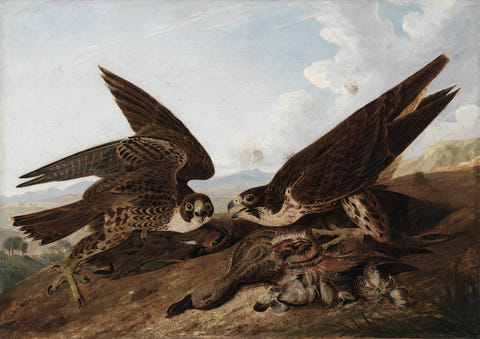
1827–1838
c. 1670–90
1817–24
c. 1650