
Man with a Hoe
c. 1882
National Gallery of ArtOriginal work, c. 1882
A stone breaker works low to the ground against a warm, earthy field. Seurat uses solid shapes and a restrained palette to give the labourer a strong presence.
A fine-art giclée reproduction on 200 gsm uncoated paper. The complete composition is presented with a white paper border. Choose from the available sizes and unframed or framed finishes.
£19.50
From museum archives. No recolouring, retouching or AI enhancement.
UK delivery. Unframed £4.99, free from £50. Wood-frame delivery included.
Fine-art print on 200 gsm enhanced matte paper. Measurements are the paper dimensions, including the white border. Framing adds to the overall dimensions. The artwork keeps its approved composition within those margins. White, natural and dark wood frames are ready to hang with plexiglass.
Our print guideA stone breaker works low to the ground against a warm, earthy field. Seurat uses solid shapes and a restrained palette to give the labourer a strong presence.
A fine-art giclée reproduction on 200 gsm uncoated paper. The complete composition is presented with a white paper border. Choose from the available sizes and unframed or framed finishes.
French · 1859–1891
Georges Seurat was born in 1859 and trained at the École des Beaux-Arts in Paris with Henri Lehmann, a pupil of Ingres. Study of older paintings at the Louvre accompanied an interest in the modern world around him. His Conté crayon drawings explored subtle transitions of tone, while painting offered another way to investigate the relationship between a clear structure and a living surface.
Seurat developed an approach that combined academic discipline with an interest in Impressionism and contemporary theories of colour. Bathers at Asnières became an important early statement of his ambitions. Carefully organised figures and spaces gave modern urban life the scale of a substantial composition. The pointillist technique associated with his mature work grew within this larger investigation of how colour, light and pictorial order could work together.
Explore Georges Seurat prints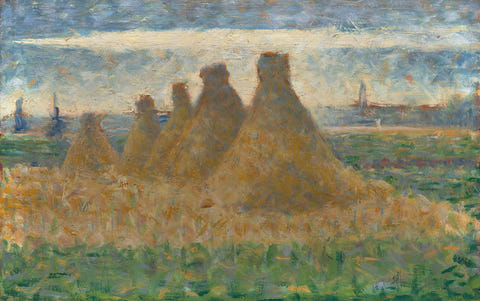
c. 1882

1897

1890-91
1888-1890