Tsukioka Yoshitoshi (1839–1892) was a Japanese artist. Yoshitoshi's career crossed the transition from the Edo period into the Meiji era. Woodblock printing continued to change as photography and other forms of image reproduction entered Japanese visual culture. He developed dramatic designs within that changing environment, drawing on stories, historical figures and supernatural subjects. New Forms of Thirty-Six Ghosts shows the range of that interest: each sheet gives a different tale its own setting, pace and combination of human and uncanny forms.
The selected works belong to New Forms of Thirty-Six Ghosts. Each gives a supernatural tale a different visual setting: an umbrella and bird, animated figures and objects, or a warrior beneath the moon. The stories become legible through gesture as much as through detail.
The selected pictures
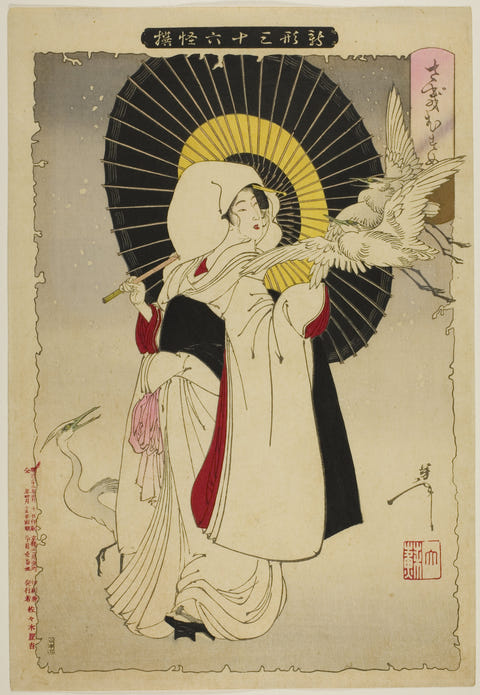
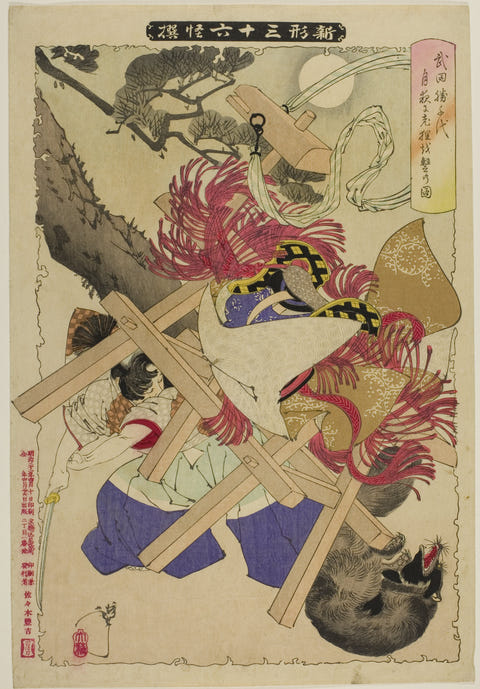
Heron Maiden: A white-clad figure stands beneath a dark umbrella beside a heron. Yoshitoshi balances pale flowing garments with clear outlines in this image from New Forms of Thirty-Six Ghosts. The Old Badger: Figures and animated objects crowd a vivid scene beneath twisting branches. Yoshitoshi uses bold red passages and intersecting diagonals to bring the supernatural encounter to life. Omori Hikoshichi: A warrior carries a woman beneath a broad moon in Yoshitoshi’s ghost-story print. Patterned robes and sharply drawn gestures give the pair a strong presence in the quiet landscape.
In a colour print, shape and colour work together at several scales. A broad area can make the main subject immediately legible, while a much finer contour gives a sleeve, feather or branch its particular character. Open paper also contributes to the arrangement rather than merely filling the space between objects. Follow the largest colour shape first, then compare it with a neighbouring passage that is lighter, darker or more finely marked. That shift reveals how the design holds descriptive detail within a clear overall rhythm, allowing the complete image and its smallest incidents to remain closely connected.
Looking closely
Ghost stories and striking human figures brought to life in colour and line.
Begin with the largest forms, then follow the smaller marks that connect them. In Heron Maiden, compare the subject with the space around it and the way light moves between them. Return to the complete picture after looking at a detail: its effect depends on the relationship of those parts, and the arrangement often reveals something different on a second visit.
Art to live with.
Fine-art prints on 200 gsm paper. Choose unframed or explore the available frame finishes, in a size that suits your space.