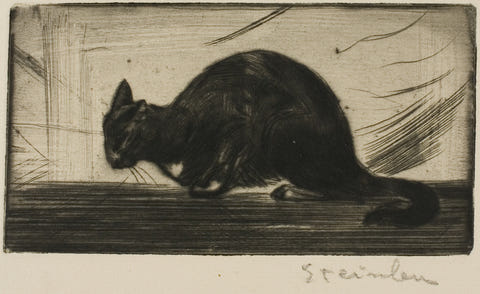
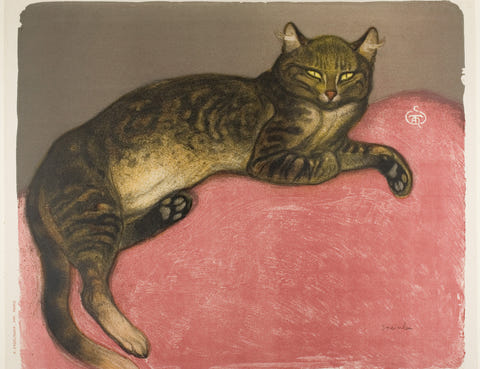
Théophile-Alexandre Pierre Steinlen (1859–1923) was a French, born in Switzerland artist. Steinlen was born in Switzerland and developed his career in France. His practice included drawing, painting, posters and printed illustrations, often associated with the visual life of Paris and its periodicals. Cats became a recurring subject through which he explored contour, movement and personality. The selected pictures show how varied that subject could be: a sharp silhouette and a relaxed animal on a cushion call for different marks, yet each makes posture central to the image.
The arched black cat and the tabby on a cushion offer two different encounters with the same animal subject. One is tense and sharply silhouetted; the other spreads its weight across a soft coloured surface. Steinlen makes posture a way of describing character.
The selected pictures
Cat Arching Its Back: A black cat arches its back on a strongly lined surface. Steinlen catches the animal’s tense posture through a bold silhouette and closely worked fur. Winter — Cat on a Cushion: A tabby cat lies across a pink cushion, looking directly out of the picture. Steinlen balances the animal’s dark markings with broad areas of warm colour.
A printed image asks the viewer to distinguish several kinds of mark. An outline establishes a boundary, closely gathered strokes create depth or shadow, and an open passage lets the paper remain part of the picture. Those differences can describe a material surface while also guiding attention through the whole composition. Begin with the main grouping, then follow one smaller passage into its surroundings. The connection between the two scales is often where a simple subject becomes a more complex image, with repeated lines and carefully spaced shapes contributing as much as the objects they describe.
Looking closely
Cats observed through bold silhouettes, lively contours and warm colour.
Begin with the largest forms, then follow the smaller marks that connect them. In Cat Arching Its Back, compare the subject with the space around it and the way light moves between them. Return to the complete picture after looking at a detail: its effect depends on the relationship of those parts, and the arrangement often reveals something different on a second visit.
Art to live with.
Fine-art prints on 200 gsm paper. Choose unframed or explore the available frame finishes, in a size that suits your space.