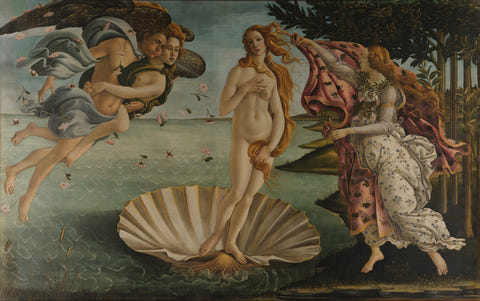
Sandro Botticelli was born Alessandro di Mariano Filipepi in Florence around 1445. He trained with Fra Filippo Lippi and had established his own workshop by 1470. Religious paintings and ambitious secular subjects brought him recognition, supported by patrons within the Medici circle. Florence remained the centre of almost his entire career.
The first pleasure of his painting often lies in a contour. Follow the edge of a sleeve, a lock of hair or the meeting of a figure and the surrounding air. These lines give each form a precise place within the picture. Their movement can unite distant areas, making a crowded scene feel delicately connected rather than heavy or fixed.
Myth and moving figures
Botticelli was called to Rome in 1481 to help decorate the Sistine Chapel. After returning to Florence, he continued the highly productive period that gave rise to his celebrated mythologies. Primavera and The Birth of Venus combine classical subjects with a strong decorative sense of line and arrangement.
In The Birth of Venus, the wind, hair and cloth all encourage the eye to move across the surface. The central figure stands between those currents, while the shell supplies another clear curve below. Primavera creates a denser experience: figures appear against dark foliage, separated by gestures and small intervals of light. Compare the spaces between them before turning to the flowers and leaves that enrich the setting.
A reputation renewed
The political and religious upheavals of late fifteenth-century Florence coincided with changes in Botticelli’s art. His later religious pictures can have a more urgent and severe character than the earlier mythologies. After his death in 1510, his wider reputation diminished before renewed interest in the nineteenth century.
His pictures reward both a close and a distant view. From farther away, the large silhouettes establish the arrangement. Moving closer reveals the small turns that make a gesture eloquent: a hand, a bending neck or the angle of a foot. Let those details lead back into the whole composition. Their delicacy gains meaning from the broad rhythm that holds the figures together across the painted surface.
Art to live with.
Fine-art prints on 200 gsm paper. Choose unframed or explore the available frame finishes, in a size that suits your space.