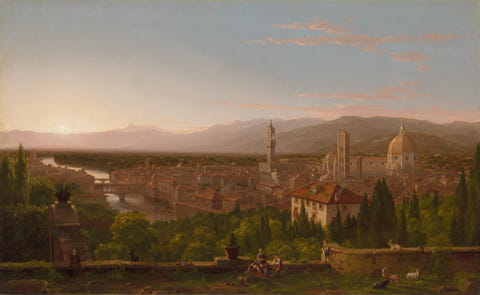
Vale of Kashmir
1867
Make this work part of your everyday. Choose a size and frame finish to find its place in your home.
From £19.50
Choose size & frame1821–1872 · American
Expansive landscapes and luminous distance. A distinctive voice in the story of nineteenth-century American art.
1 print · Your size. Your frame.
1867
Make this work part of your everyday. Choose a size and frame finish to find its place in your home.
From £19.50
Choose size & frameRobert S. Duncanson was born in Fayette, New York, and developed his artistic career in Cincinnati. He became the best-known African American painter in the years surrounding the American Civil War. Working within a deeply unequal society, he established a reputation through ambitious landscape painting. His career also took him beyond the United States, with activity in England, Scotland and Italy.
Cincinnati offered both an active cultural setting and the realities of life near the boundary between free and slave states. Duncanson developed a network of supporters who recognised his ability. Nicholas Longworth commissioned landscape murals for his home between 1850 and 1852, creating an important professional opportunity and a substantial surviving record of the painter’s early ambition.
Duncanson’s work belongs to the nineteenth-century tradition of Romantic landscape. Natural settings can hold associations with literature, hope and the possibility of a different world. His paintings combine organised spaces with atmospheric distance, inviting attention to the route from foreground to horizon. Human presence, when included, can give the wider view both scale and a sense of inhabitation.
Longworth also helped support Duncanson’s first European journey in 1853. Encounters with art abroad widened the resources available to his painting. Literary subjects and landscape could carry aspiration beyond a straightforward record of a place. His professional reputation increasingly crossed national borders, demonstrating the reach of a career developed against the restrictions of a deeply unequal society.
During the Civil War he worked in Canada, and later travelled in Britain. The international recognition he received was unusual for an African American artist of his generation. The murals now preserved at the Taft Museum and paintings in major collections help restore the breadth of his achievement, connecting intimate passages of landscape with a substantial public career.
Duncanson died in Detroit in 1872. His landscapes continue to offer a compelling encounter with light, space and artistic ambition. Look at how the distant view is framed by the nearer forms: the eye is guided outward, while the foreground gives it a place to begin. The result can feel spacious without losing its intimacy or its carefully composed order.
Art from museum archives, without recolouring, retouching or AI enhancement. Printed on 200 gsm paper, in your choice of size and frame.