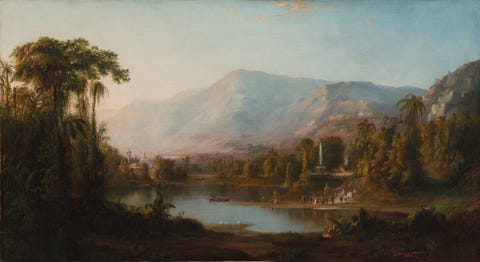
Albert Bierstadt became one of the most successful painters associated with the Hudson River School. His career belonged to a period when American landscape painting took on new scale and public importance. Mountains, lakes and forests provided subjects for an art that joined natural detail to a powerful sense of spectacle, making distant places vivid for viewers.
Born in Solingen, Germany, he grew up in New Bedford, Massachusetts, after his family emigrated. He taught drawing before returning to Europe in 1853. Time among painters in Düsseldorf and sketching journeys through European mountain scenery developed the skills he would later use to describe the American West on an extraordinary scale.
Detail and vastness
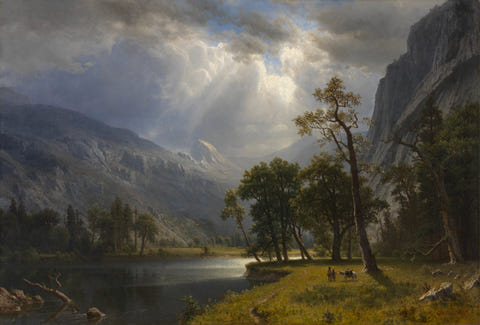
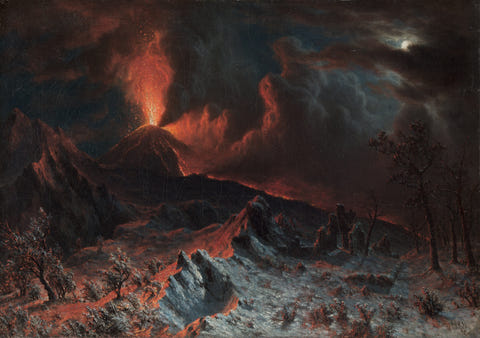
Bierstadt’s landscapes place carefully observed features within expansive compositions. Trees and rocks lead the eye toward mountains, while water and atmosphere create passages between distances. His paintings belong to a wider nineteenth-century fascination with landscape and national identity. Their grandeur depends on contrast: the small foreground detail makes the great sweep of the view feel larger.
In 1859 he travelled west with Frederick W. Lander’s survey expedition, gathering material for paintings completed after his return. A visit to Yosemite in 1863 extended that experience. Studies, photographs and memories fed large studio compositions. Their public success made Bierstadt a celebrated artist, with paintings commanding substantial prices and turning distant landscapes into widely recognised images.
A horizon worth following
Further western journeys sustained his subjects, but changing tastes in the 1880s diminished his popularity. The shift illustrates how dramatically a successful artist’s fortunes could change within a lifetime. His landscapes remain influential images of mountains and wilderness, and also carefully made compositions whose light and arrangement transform field observations into an idealised vision.
Bierstadt died in 1902, leaving a body of work celebrated for its dramatic light and commanding vistas. In his paintings, the landscape unfolds by degrees. Start with the near shore or a cluster of trees, then let the eye travel toward the light. Each change of scale offers a different experience, from something almost tangible to a distance that feels boundless.
Printed faithfully.
Art from museum archives, without recolouring, retouching or AI enhancement. Printed on 200 gsm paper, in your choice of size and frame.