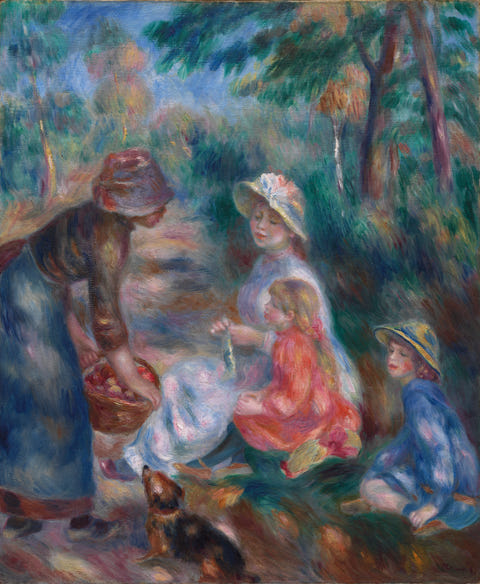
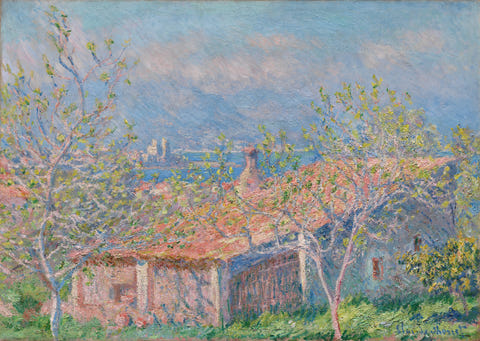
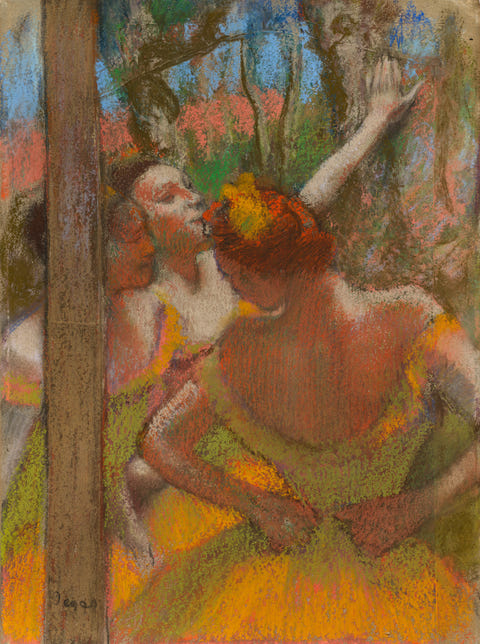
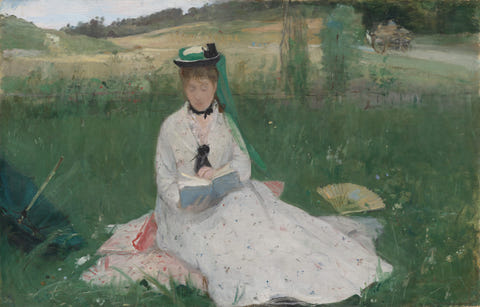
Pierre-Auguste Renoir was born in Limoges and moved with his family to Paris as a child. The city became the setting for his development as an artist. Alongside painters such as Monet and Degas, he helped build an alternative to the official exhibition system. In 1874 he participated in the first Impressionist exhibition, placing contemporary experience at the centre of painting.
Before becoming an independent painter, Renoir decorated porcelain, learning to handle colour as part of a practical trade. He copied paintings at the Louvre and entered Charles Gleyre’s studio in 1862. Friendships with Monet, Sisley and Bazille encouraged outdoor work, while his admiration for earlier French painting continued to shape his treatment of figures.
Light with a human presence
Renoir’s landscapes and figure paintings are distinguished by soft edges, vivid colour and a warm response to the people he depicts. Rather than isolating a figure from its surroundings, he allows light and colour to pass between them. His work ranges from intimate studies to social scenes, finding pictorial richness in a face, a dress, a garden or a shared afternoon.
After 1877 he stopped exhibiting with the Impressionist group and sought a broader public. A journey to Italy in 1881 sharpened his interest in older art and in the construction of the human figure. The ensuing changes were deliberate experiments, showing an artist willing to reconsider the very methods that had helped establish his reputation.
A changing artistic language
His later paintings brought increasingly full forms and a warmer, more monumental treatment of the body. This work extended well beyond the familiar image of an Impressionist recording a passing scene. Renoir continued to change into the twentieth century, and his later approach proved important to younger painters, including Picasso, who studied its combination of simplicity and weight.
Renoir’s approach evolved beyond his early Impressionist years. Classical and Renaissance art encouraged renewed attention to drawing and the structure of the figure. He continued developing his painting across a long career, dying in 1919. In his work, colour can give a simple subject an expansive mood. Look for the small warm notes that bring life to the surrounding greens and shadows.
Art to live with.
Fine-art prints on 200 gsm paper. Choose unframed or explore the available frame finishes, in a size that suits your space.