John Constable was born in East Bergholt, Suffolk. The countryside around his home became an enduring source of feeling and subject matter. Largely self-taught in his early development, he entered the Royal Academy Schools around the turn of the century. Dutch landscape painting and the work of Rubens and Claude helped inform his understanding of colour and composition.
His father’s business connected the family to the mills and waterways of the Stour valley. Constable gathered advice, books and borrowed prints before entering the Royal Academy Schools in 1799. London supplied training and access to buyers, but the emotional centre of his work remained the countryside where he had grown up and learned to observe.
Observation in the open air
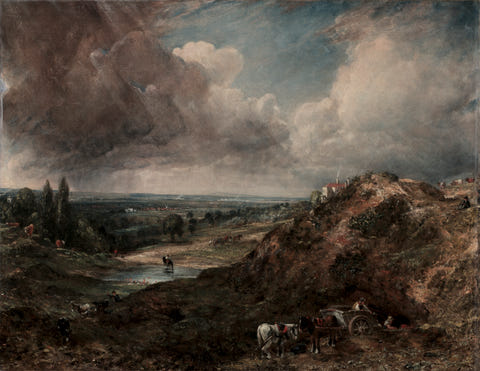
Constable made numerous outdoor sketches, using direct observation to prepare larger paintings worked up in the studio. His art brings close attention to weather and the appearance of familiar places. Rather than seeking landscape only as an idealised setting, he gave ordinary fields, ponds and waterways a powerful pictorial presence. The sky became an active part of that experience.
He married Maria Bicknell in 1816, and the demands of a growing family made commercial success increasingly important. His large Stour paintings, including The Hay Wain, developed through drawings, small studies and full-size oil sketches. The apparent freshness of the finished view therefore rested on a long process of testing composition, colour and the balance of light.
A wider influence
Hampstead supplied new skies and weather studies, while Salisbury and Brighton extended his subjects beyond Suffolk. Changes in family circumstances shaped where he lived and worked. His example travelled further still: French painters responded to the vitality of his surfaces, carrying his close observation of a particular English landscape into wider debates about how nature could be painted.
Constable’s paintings met a mixed reception in England during his lifetime, while finding considerable success in Paris. His example influenced French Romantic painting and the Barbizon School. He died in 1837. Look at the relationship between a patch of brightness and the surrounding atmosphere: a small change of light can make the whole landscape feel newly alive.
Printed faithfully.
Art from museum archives, without recolouring, retouching or AI enhancement. Printed on 200 gsm paper, in your choice of size and frame.