Villas at Trouville
1884
Make this work part of your everyday. Choose a size and frame finish to find its place in your home.
From $29.00
Choose size & frame1848–1894 · French
Modern views with unexpected angles. City streets, coastal villas and gardens seen through a painter’s deliberate eye.
1 print · Your size. Your frame.
1884
Make this work part of your everyday. Choose a size and frame finish to find its place in your home.
From $29.00
Choose size & frameGustave Caillebotte was born in 1848 and trained as a painter with Léon Bonnat. The first Impressionist exhibition in 1874 helped draw him toward the independent group. He took part in its second exhibition in 1876, showing work that brought contemporary subjects and a strong sense of pictorial structure into conversation with new approaches to painting.
Financial independence allowed him to support fellow artists as well as pursue his own work. He collected paintings by members of the Impressionist circle, helping sustain careers that did not always receive official approval. His place within the movement therefore combined the practical work of patronage with an increasingly distinctive artistic contribution.
Caillebotte’s paintings can make a familiar scene feel newly arranged. A steep angle, a close foreground or a carefully placed architectural form establishes the viewer’s position. Modern Paris supplied important subjects, while country houses, gardens and waterside settings gave him other ways to explore the relationship between built structures and surrounding light.
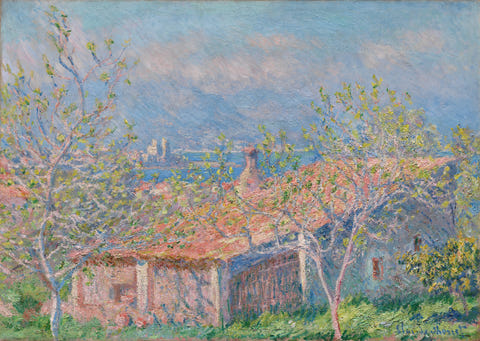
Villas at Trouville offers a coastal view in which houses, vegetation and sea occupy connected bands of the composition. Look at the way the buildings hold their shape against the more broken marks of the plants. The painting’s spaciousness comes from those relationships, with colour and structure working together to lead the eye outward.
Caillebotte’s later interests included gardening, sailing and boat design. He died in 1894, leaving a collection of Impressionist art to the French state. That bequest became an important part of his public legacy, sometimes drawing attention away from the paintings he had made himself. Many of those works had remained in private hands.
His pictures deserve time on their own terms. Notice how a solid architectural form can steady a scene while a changing surface of leaves or water brings it to life. A viewpoint is never merely a place from which to observe: it determines the image’s balance and the route our attention follows. That deliberate organisation gives his landscapes their particular combination of immediacy and order.
Fine-art prints on 200 gsm paper. Choose unframed or explore the available frame finishes, in a size that suits your space.