Francisco de Goya (1746–1828) was a Spanish artist. Goya trained in Zaragoza before establishing his career in Madrid, eventually working for the Spanish court. A serious illness in the early 1790s left him deaf. His independent prints developed a sharp interest in the tensions between social convention and private imagination. Los Caprichos brings those concerns together in a series that moves between recognisable human behaviour and impossible encounters. The selected images reward reading their titles alongside the gestures and arrangements within the pictures.
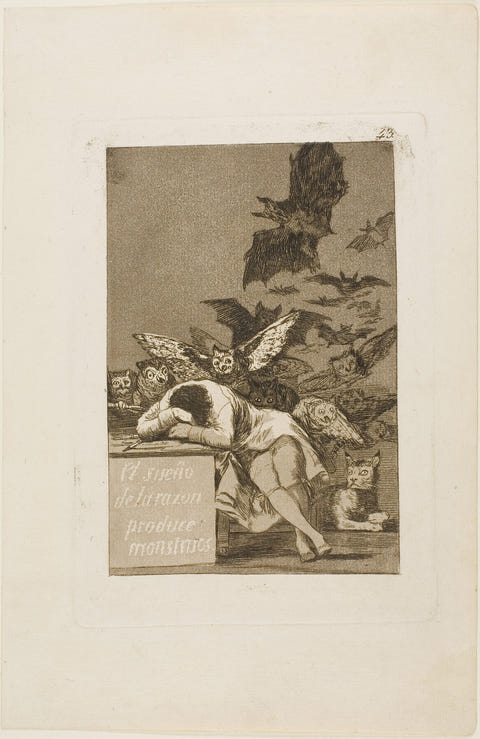
Goya’s Los Caprichos comprises eighty prints that satirise Spanish society at the end of the eighteenth century. The Sleep of Reason Produces Monsters places a sleeping artist among the creatures of his imagination. Throughout the series, humour and unease remain closely connected.
The selected pictures
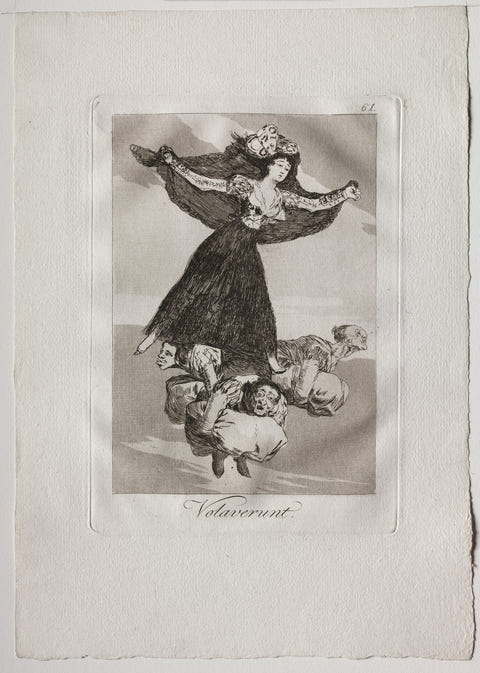
The Sleep of Reason Produces Monsters: A sleeping figure is surrounded by owls and bats in Goya’s celebrated image from Los Caprichos. The complete historic sheet retains the printed title beneath the scene. They Have Flown: A woman and several shadowy companions rise into the air in this plate from Los Caprichos. Goya combines precise etched figures with an atmosphere of improbable flight. When Day Breaks We Will Be Off: Figures gather beneath a dark, star-filled sky in Goya’s nocturnal scene. Their gestures and closely grouped bodies give the image a tense, theatrical rhythm. Here Comes the Bogeyman: A white-cloaked figure approaches a mother and children in a dim interior. Goya sets the bright, blank shape against closely observed faces and deep surrounding shadow. Hobgoblins: Strange figures gather around a table beneath a barred opening. Goya’s etched lines and soft aquatint shadows bring their faces and gestures into sharp relief.
A printed image asks the viewer to distinguish several kinds of mark. An outline establishes a boundary, closely gathered strokes create depth or shadow, and an open passage lets the paper remain part of the picture. Those differences can describe a material surface while also guiding attention through the whole composition. Begin with the main grouping, then follow one smaller passage into its surroundings. The connection between the two scales is often where a simple subject becomes a more complex image, with repeated lines and carefully spaced shapes contributing as much as the objects they describe.
Looking closely
Human folly, imagination and night transformed into unforgettable printed images.
Begin with the largest forms, then follow the smaller marks that connect them. In The Sleep of Reason Produces Monsters, compare the subject with the space around it and the way light moves between them. Return to the complete picture after looking at a detail: its effect depends on the relationship of those parts, and the arrangement often reveals something different on a second visit.
Art to live with.
Fine-art prints on 200 gsm paper. Choose unframed or explore the available frame finishes, in a size that suits your space.